
 by Andrew Brusgard/photos as noted
The year 2026 marks the 100th anniversary of the New York Society of Model Engineers, widely regarded as the oldest continuously operating model railroad club in the United States. What began as a gathering of like-minded hobbyists in New York City has grown into one of the most enduring institutions in the hobby, with a legacy that spans generations of modelers, layouts, and ideas.
Founded during a time of rapid technological change and growing interest in leisure pursuits, the Society reflected a broader fascination with miniature craftsmanship. Early members explored a wide range of modeling interests — from boats and automobiles to railroads — before the organization gradually focused its efforts on model railroading. That transition mirrored the evolution of the hobby itself, as modelers moved beyond simple train sets toward more realistic and operationally rich layouts.
The Society’s origins date to 1926, a year defined by innovation and optimism. As America embraced new technologies and expanded its horizons, a group of New York-area modelbuilders came together to share ideas, techniques, and a passion for building things in miniature. The New York Society of Model Engineers was born from that collaboration, and its early activities reflected the diversity of interests among its members. The club’s first president, Walter Elliott, was a model boat builder, and the Society’s first public event — a powerboat race held on Conservatory Lake in Central Park — took place just months after its founding.
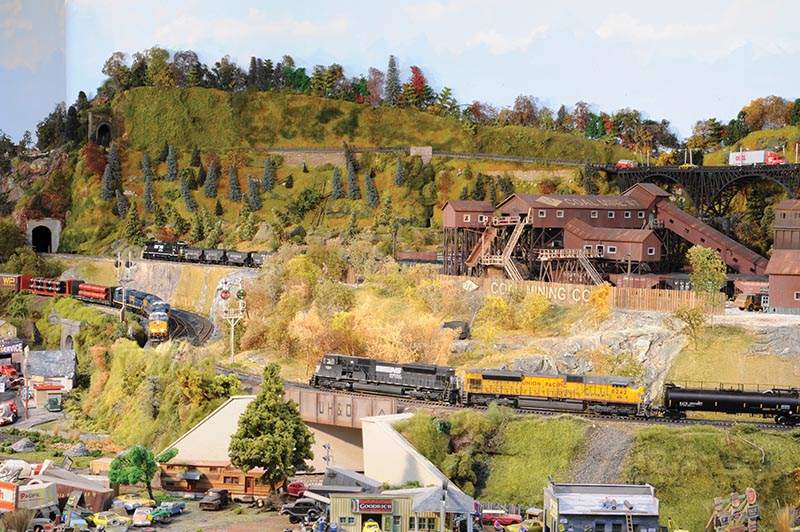
ABOVE: A CSX manifest and Norfolk Southern “Tank Train” meet below the coal mine being switched out by an Norfolk Southern local crew on New York Society of Model Engineers’ HO scale Union, Hoboken & Overland. Note the Baltimore & Ohio-style color-position light signals. —Phil Monat
Over the decades, the Society has attracted a remarkable roster of members whose contributions helped shape the hobby. Names such as Ed Alexander, Bill Walthers, Joe Fisher, Fred Auel, and Fred Icken appear in its history, alongside prominent New York families including the Vanderbilts and Astors. Their involvement speaks not only to the Society’s technical influence, but also to its broader cultural reach.
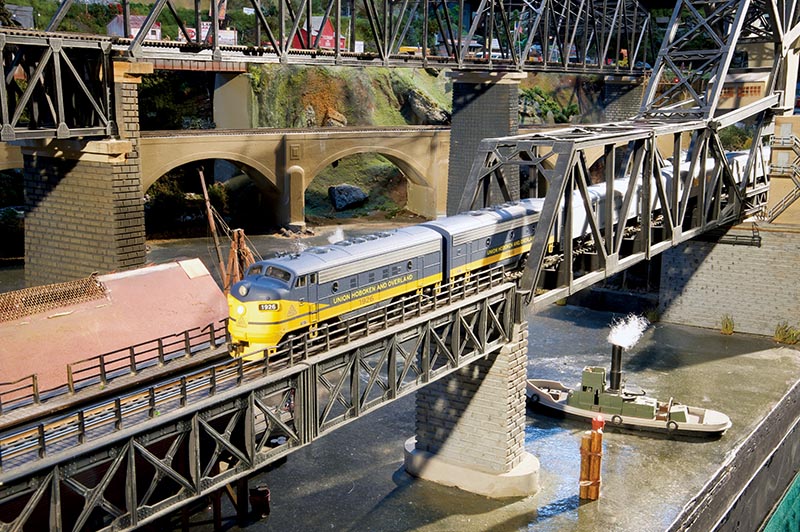
 A century later, that spirit of craftsmanship and collaboration remains at the heart of the organization. Today, the Society continues to evolve, embracing new techniques, technologies, and scales while maintaining a strong connection to its past. The HO scale Union, Hoboken & Overland Railroad featured here is the latest chapter in that story — a modern expression of a tradition that began 100 years ago.
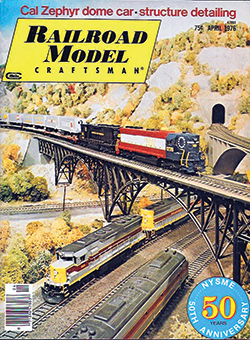
Back in 1976, I wrote an article for the April issue of Railroad Model Craftsman titled “The First 50 Years of NYSME.” At the time, it was the longest article ever published in RMC. It covered the Society’s early history, our move out of New York City, and the construction of the O scale “Lackawanna-inspired” layout in the Hoboken Terminal of the Delaware, Lackawanna & Western.
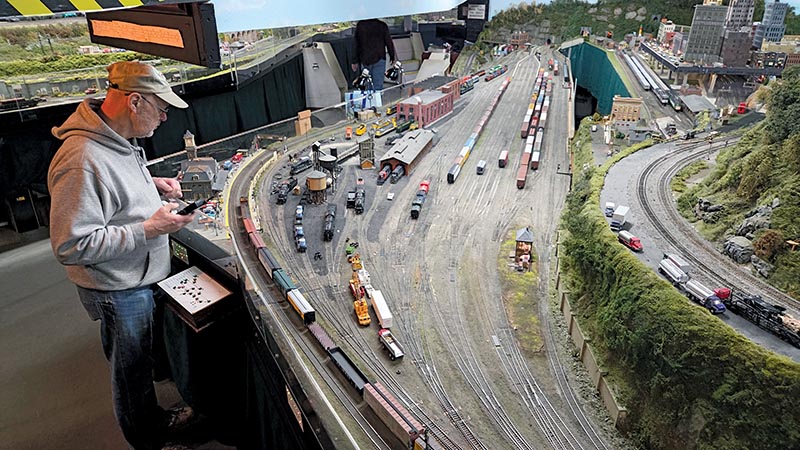
ABOVE: NYSME member Jeff Burek operates out-bound end of freight yard and lower end hump tracks to assemble trains. The small panel in front of him contains push-button control for all switches in area. During exhibitions this panel is unplugged and moved to the balcony overseeing area and operates from there. —Otto M. Vondrak
The article also described our 1956 move from Hoboken Terminal and the purchase of our present home in Carlstadt, N.J., just a stone’s throw from the Meadowlands, with a clear view of the New York City skyline across the Hudson River. It went on to document the construction and operation of both the O scale Union Connecting Railroad and the HO scale Union, Hoboken & Overland layouts that defined the Society during that era.
Changing Times
A few years after my 1976 article, the NYSME membership began to recognize that the HO railroad — while updated in many areas over the years — no longer reflected the evolving direction of the hobby. It had become “running” layout than one designed for modern operations.
As the HO layout approached its 20th year, age-related issues were also becoming apparent. The Atlas fiber-tie flex track, which had been state-of-the-art in the 1950s, was increasingly affected by humidity changes that caused sections to go out of gauge. The diorama-style presentation limited opportunities for visitors to view trains up close, and the scenery base itself was beginning to deteriorate.

ABOVE: The early Conrail era is represented on many levels with a manifest led by a former Reading unit on the top level, three Erie Lackawanna units leading a hot auto parts train on the concrete viaduct, and two Penn Central units leading a freight on the third level. Susquehanna units switch out the customers at ground level. —Andy Chabot
Perhaps most significantly, the layout was not designed for operations, only for moving trains around the railroad. As prototytpe operations were becoming more popular with the introduction of more sophisticated walkaround controls, members expressed frustration with their current layout.
A decision was made by vote of the HO membership: it was time for the old layout to go. A list of requirements and ideas was developed, and members were invited to submit design proposals — essentially creating a friendly in-house design competition. Several plans were presented for consideration.
One proposal, developed by member Fred Wadleigh — who passed away only recently — met most, if not all, of the established requirements. Following the close of the 1984 open house season, teardown of the old layout began almost immediately. Much of the existing L-girder benchwork was preserved and modified to fit the new design.
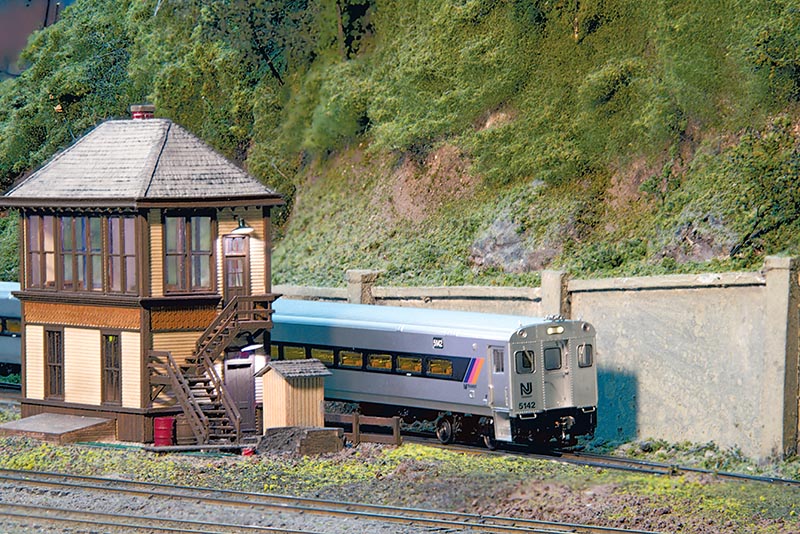
ABOVE: An NJ Transit commuter train runs “wrong rail” against the normal flow of traffic past East End Tower at the UH&O’s main freight yard. The JMRI-based computerized dispatching system allows trains to operate safely on any track in either direction. —Andy Chabot
Because the new railroad would be a walk-around layout, a three-and-a-half-foot-wide aisle was created where the previous layout had been attached to two walls. Many members were amazed at how quickly the old layout was dismantled.
At about the same time, members began installing new risers and roadbed sections, working from the selected and approved plan. Because the layout occupied two rooms, multiple crews could work simultaneously in different areas. Much like building a real railroad, this approach allowed construction to move quickly, with each team’s work eventually tying in with the others.
Within eight months, a 12-track staging yard was completed and enough main line was in place to allow trains to run for the next open house. All of the trackwork, including the turnouts, was hand-laid using Code 83 nickel-silver rail. This marked the beginning of NYSME’s third HO layout.
The Layout Today
The HO scale Union, Hoboken & Overland layout occupies approximately 30×45 feet and is divided between two rooms. It is fully scenicked, with miles of scale track, bridges and tunnels, towns and villages, farms and factories, rivers and lakes, passenger stations, and rural crossings, inspired by the landscape of northern New Jersey. More than 50,000 miniature trees have been installed by members to recreate that setting…
