
 by Jason Baxter/photos by the author
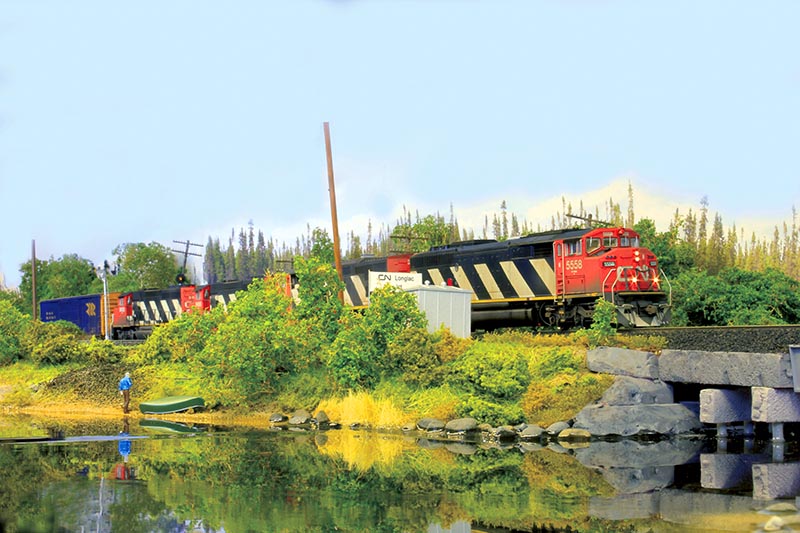
Welcome to my HO scale Canadian National Caramat Subdivision. This is a basement-sized model railroad that allows me to recreate Class I main line railroading as it was in the mid-1990s, when I first became fascinated with railroads. I grew up watching trains from my grandmother’s house that was located across from the CN in Nakina, Ont. Finally building my dream layout has been both challenging and very rewarding.
The Prototype
The Caramat Subdivision is located in Northwestern Ontario. It is a small part of CN’s transcontinental main line. It begins with the town of Hornepayne and ends at Armstrong, 243.8 miles to the west. The subdivision is isolated as it traverses the Canadian wilderness. It is a single-track main line with numerous passing sidings and is controlled by Centralized Traffic Control (CTC). In the 1990s, the Rail Traffic Controller (RTC) was located in Toronto. It was a busy railroad in the era I model, with upwards of 20 trains a day. It also saw a tri-weekly passenger train, VIA Rail’s flagship The Canadian.
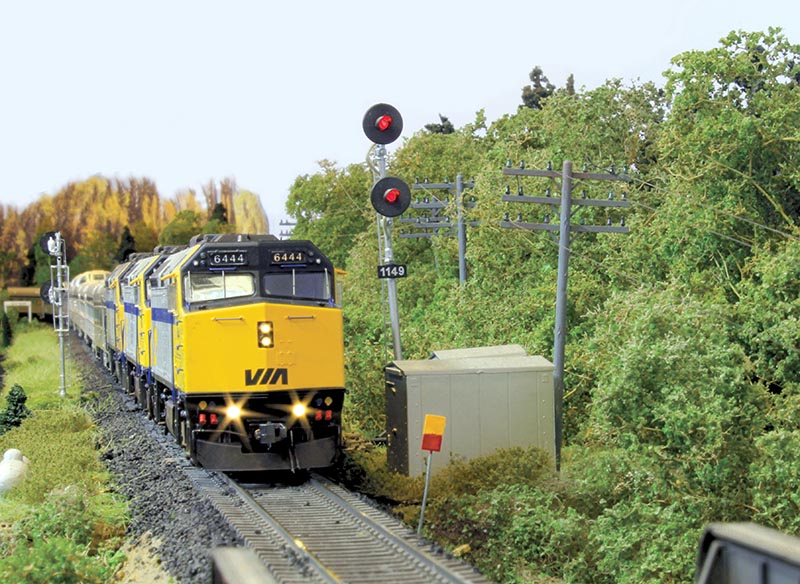
ABOVE: The eastbound VIA Rail Canadian is seen here at Bawk East, having just traveled through a foreman’s Rule 42 work limits. The scene takes place on the author’s HO scale model railroad inspired by operations on Canandian National’s Caramat Sub in the 1990s.
Design Philosphy
This layout was built to relive fond childhood memories. My grandmother’s house was built on a hill directly across from the tracks. Whenever I would hear a train coming, I would literally run from the back of the house to the front living room to watch it go by. My father also worked for CN as a track maintainer and retired after 33 years of service. Growing up around the railway instilled a love for trains. I always knew that someday I would build an HO scale layout of this area.
Setting the layout in the mid-1990s allows a variety of motive power to be used. At that time, CN used a mix of four- and six-axle EMDs, plus newer GEs, and Alcos and MLWs (including C-630Ms, M-420s and Bombardier HR-616s) in the twilight of their service careers. VIA used F40PH-2s for motive power (and still does). The majority of the locomotives were CN’s wide-nose “safety cab” versions, although on rare occasions leased units could be seen leading trains. Canadian Pacific detours trains were also seen when there was a derailment on the CP main line.
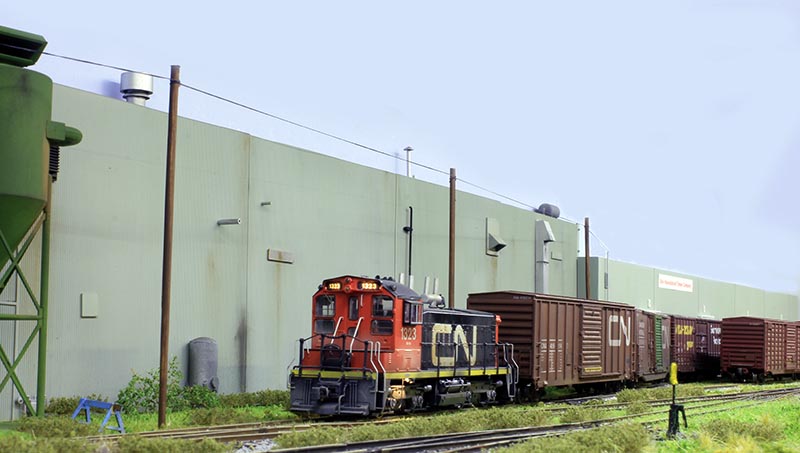
ABOVE: CN SW1200 1323 services the Olav Haavaldsrud mill in Hornepayne. The crew is spotting boxcars that will be loaded with lumber for outbound shipment.
The Layout
Sadly, the basement wasn’t large enough to model the full 243.8 miles of track, so I chose to focus on approximately 36 miles between the town of Longlac and Exton siding to the west. This allowed me to recreate Nakina and add some operating interest to the layout. Longlac and Exton both had forestry industry mills that were serviced by rail during the 1990s. I also chose to model Hornepayne and Armstrong. Having both ends of the subdivision on the layout creates a sense of distance for operators when running trains.
I started building the layout in August 2018, after realizing the small layout that was occupying a third of the basement no longer held my interest. Running trains in a circle with no sense of purpose was simply not appealing anymore. I wanted to run trains prototypically and accurately.
The Caramat Sub began as two small upper and lower shelves running around the exterior basement walls. The two decks were connected by a helix in the middle of the layout. It was built as a point-to-point layout. The “last spike” occurred on December 2018.
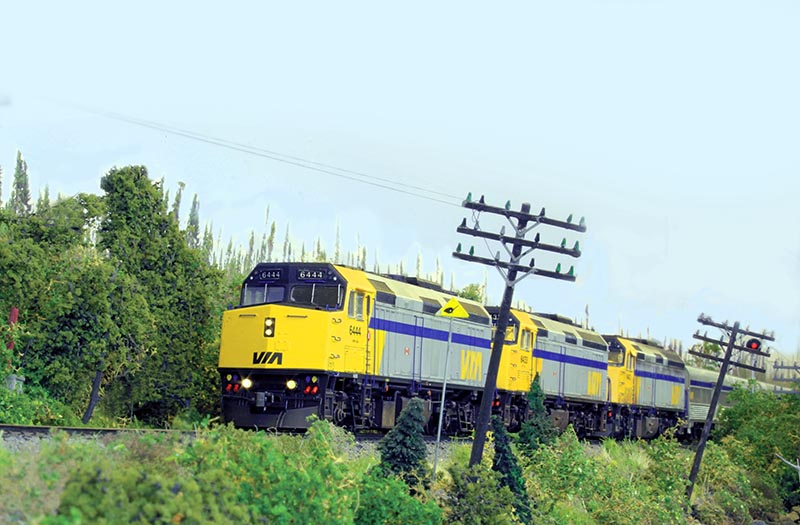
ABOVE: Three units lead VIA Rail’s flagship train this morning. VIA 6444 used to be a common sight on the Canadian. Sadly it was wrecked in a derailment on February 6, 2012, in which two crew members lost their lives.
After a year or two, however, I grew tired of the point-to-point format. I finally committed the entire basement to the layout. I built the Hornepayne and Armstrong benchwork in the middle of the basement, along with a second helix that connects the upper and lower decks. The helix has two staging tracks, one for eastbound trains and the other for westbounds. This addition eliminated the point-to-point main line and it added approximately 60’ to the length of the main line run. It also allowed Hornepayne and Armstrong to have their own yards, following the prototype.
Two years after the Hornepayne/Armstrong portion of the layout was built, I decided to add a small shelf in the crew lounge area. This 16’-long L-shaped shelf provided more switching opportunities and created one standalone job for operating sessions. The shelf is 12” wide and holds two industries. The first is a sawmill loosely based on the Olav Haavaldsrud Timber Company. The second is a fictitious mill that produces paper products. A lot is packed into a small area and it is quite challenging to switch both mills.
I tried to follow the prototype track plan as closely as possible. The layout is a single-track main line, with four sidings between Hornepayne and Armstrong. Longlac and Exton both have rail-served mills.
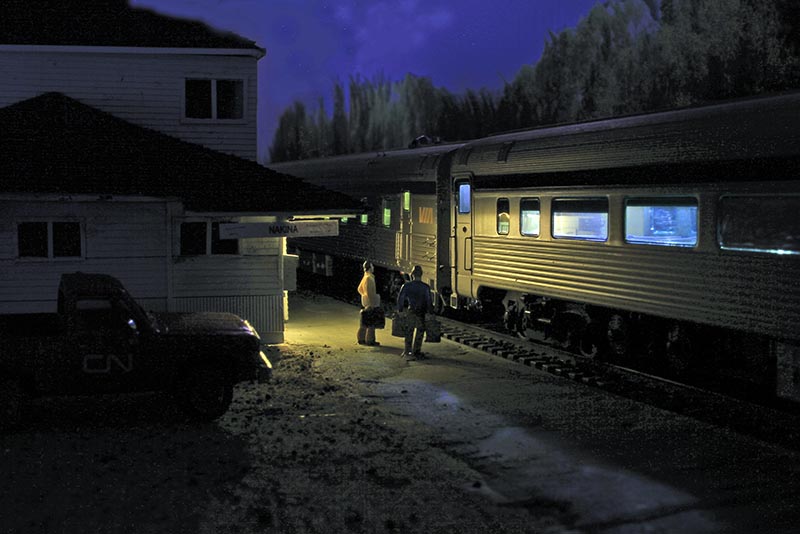
ABOVE: VIA Rail’s Canadian makes a late-night station stop at Nakina. A couple of passengers are waiting for the train to stop at their sleeping car. They are headed westbound on Train 1.
The layout was designed with realistic operations in mind and features fully functional CTC. The system uses Digitrax hardware paired with JMRI software, and radio communication allows train crews to contact the RTC when needed. During operating sessions, the railroad comfortably supports six operators plus a Rail Traffic Controller, with a variety of jobs available to keep everyone engaged.
Traffic ranges from main line intermodal trains to road switchers, work trains, passenger trains, and yard assignments. Average train length is about 22 cars, typically powered by two or three locomotives. The roster includes approximately 250 freight cars and 30 locomotives.
VIA Rail’s The Canadian is my personal favorite. I’ve been fortunate to ride the real train several times, and I looked forward to the day I would model it in HO scale. Thanks to Rapido Trains producing the necessary locomotives and rolling stock, that goal became reality. It took nearly 10 years to assemble enough cars, but I can now run both the westbound and eastbound versions of the train on the layout. Each train is 13 cars long, with a consist accurate to the 1990s era. They are truly the crown jewels of the railroad…
