
 by Doug Geiger, MMR/photos by the author
In 1955, the Denver & Rio Grande Western Railroad was busy dismantling its narrow gauge line over Marshall Pass. Since the 1880s, this route had connected Denver with Colorado’s high country. In August of 1955, a young model railroader named Art Lort made a trip to visit that part of central Colorado. He was taken by the vastness and beauty of Marshall Pass and the surrounding area. Although that line had not seen any revenue trains for about two years, Art could easily imagine those early railroaders coaxing their little engines up and over the 4 percent grades of Marshall Pass. Tiny compared to their standard gauge brothers, those tough little Consolidations and Mikados struggled to handle long strings of wooden cars. In those early days, personal travel was limited to trails and wagon roads, so passenger trains were an important part of the railroad scene. Art was hooked! Marshall Pass would be the theme for his future model railroad.
In October 1997, after moving into a Denver area home with an adequate basement, Art began planning and building his narrow gauge dream layout. Although the route over Marshall Pass was entirely narrow gauge, it connected with standard gauge trains at both Salida and Montrose, Colo. Originally, the prototype D&RG had been built as an all-narrow-gauge railroad. Around the turn of the 20th century the entire main line was rebuilt to standard gauge with some long segments of right-of-way remaining as narrow gauge branch lines. The entire Marshall Pass line was one of these branches, which left the standard gauge at Salida. Here the railroad maintained a huge dual-gauge yard and engine-servicing facility, as well as other facilities for the transfer of freight and passengers from one gauge to the other.
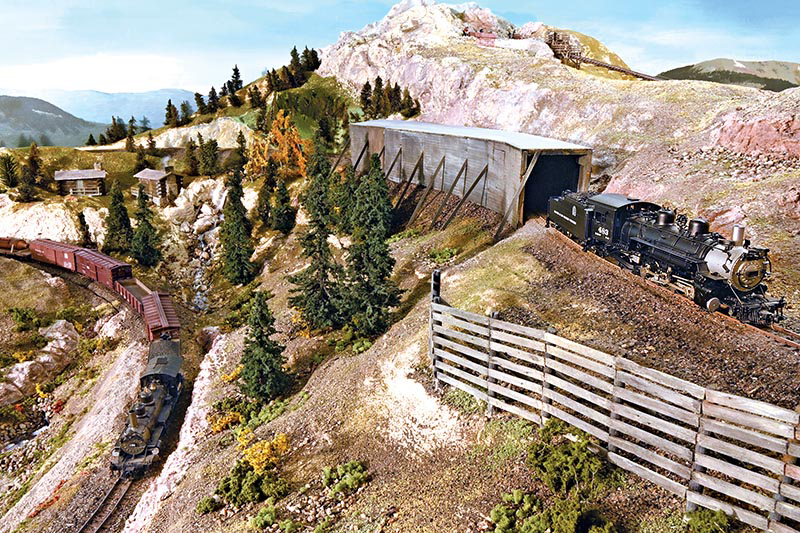
ABOVE: Rio Grande 483, a brass K-36 imported by Sunset Models, pauses near the top of Marshall Pass. On the level below, a Blackstone K-27 leads a freight train down the 2.5 percent grade toward Gunnison.
In his planning, Art decided that one of his goals was to develop the look and feel of the dual-gauge yard at Salida and to establish the idea of goods and people moving off of the narrow gauge portion of the railroad and on to other places many miles away. In Art’s final design for Salida, there are standard and narrow gauge yard tracks, as well as dual-gauge engine and transfer facilities. Leaving Salida in both directions, standard gauge tracks lead into staging yards. More about staging later. For now, let’s consider Art’s planning for the narrow gauge portion of the railroad.
When Art began his dream layout, few model railroaders embraced prototype modeling; many had freelanced layouts. Since Art wanted to capture the essence of the Marshall Pass narrow gauge, he hoped to design scenes that would resemble the prototype as closely as possible, including track arrangements, buildings and scenery. Once operations began, the traffic patterns would also mirror the prototype. To add operating interest, Art used “modeler’s license” to add some industries that were logical but didn’t actually exist on Marshall Pass. Over the years, Art had acquired a large quantity of published information and photos which were very valuable in planning for both scenery and operations.
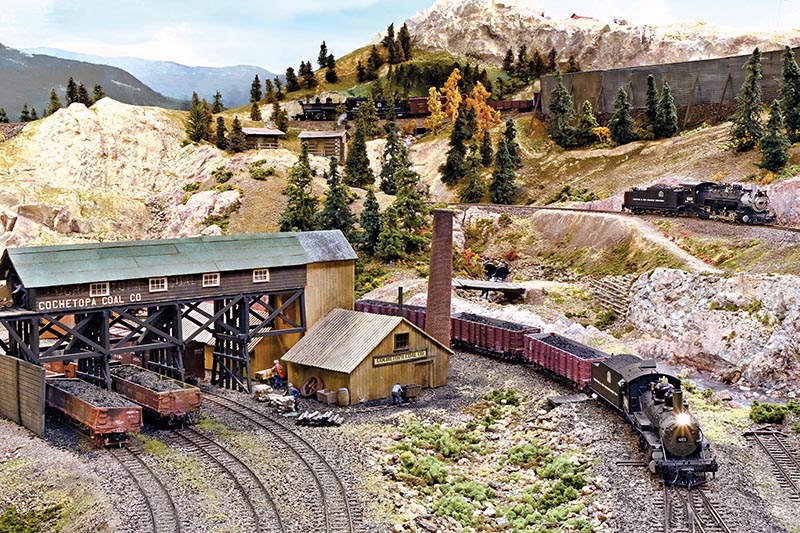
ABOVE: A coal train passes the Cochetopa Coal Co. mine at Shavano. The coal drag will wait at Shavano for the helper coming down on the middle level and the freight just emerging from the snowshed near the top of the pass.
With one end of the model railroad firmly planted in the dual-gauge town of Salida, the other end would be at Montrose in western Colorado. Art wanted to focus on the climb over Marshall Pass. Although the prototype route used 4 percent grades, Art realized that if he maintained this on the model, his Marshall Pass would go through the ceiling! The layout was designed with 2 percent grades on the narrow gauge as well as on the standard gauge. Art decided to locate two passing tracks on the east side of the pass. There is another at the top of the pass and one about halfway down the west side before arriving at Gunnison Yard.
It was important to model Gunnison since it was the gathering point for coal trains coming from the Crested Butte mines. Ultimately, Art decided that he did not have enough space to build a separate branch to Crested Butte. Instead, he constructed two coal mines on short branches coming directly off the main line. In operation, the loaded gondolas from these mines still come into Gunnison and are then forwarded to Salida.
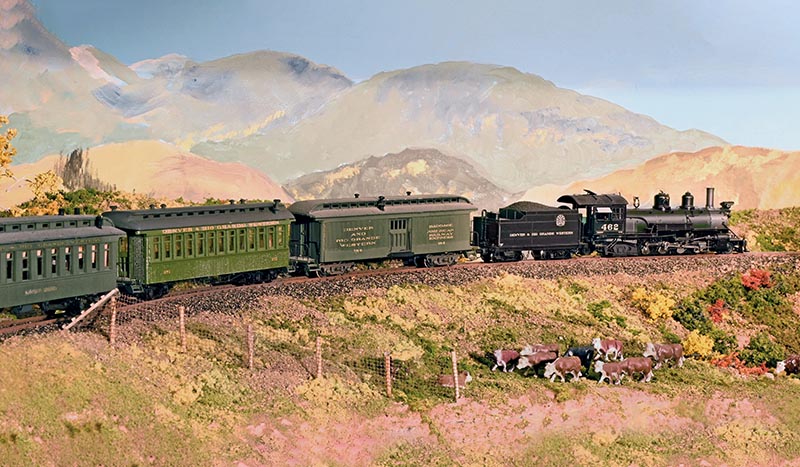
ABOVE: A short passenger train on the Alamosa Branch is headed by a Blackstone K-27.
Proceeding west from Gunnison, the route that Art chose included another passing track followed by a section of spectacular vertical scenery representing the almost-impassable Black Canyon of the Gunnison. Art believed that area had to be another focal point on his model railroad. Emerging from the Black Canyon, there is one more passing track at the tiny town of Cimarron. From there, the “skinny rails” duck out of sight briefly on a lower level below Gunnison, then emerge at Montrose. This is a five-track visible staging yard connected to a reversing loop. Montrose also includes one unpowered standard gauge track to suggest that the transportation system continues on to the west.
Art set the time frame of his new layout in 1928, a relatively prosperous time on the D&RGW in terms of freight and passenger traffic. All the “modern” narrow gauge locomotives were in service by that date, with many of the older engines still in use as well. In addition, all but one class of standard gauge locomotives was in service. This gave Art a great deal of freedom in his selection of motive power…
