
 by Ed Kapuscinski/photos as noted
Given its popularity and importance to the modern railroad scene, Conrail was only around for a brief 23 years. But what it lacked in longevity it made up for variety and modeling interest. It spanned the gap between “classic” railroading and the modern era of mega-mergers and more efficient Class 1 operation.
A bit of Conrail history makes the patterns that appear in its equipment make sense. Created by the federal government as a solution to the bankruptcy of several Northeastern railroads that reached their breaking point in the 1970s. The new “Consolidated Rail Corporation” reflected the amalgamation of Central Railroad of New Jersey, Erie Lackawanna, Lehigh & Hudson River, Lehigh Valley, Penn Central, and Reading.
Conrail began operations on April 1, 1976. It struggled through its first few years before hitting its stride in the mid-1980s when it had the world’s largest initial public offering to take it private in 1987. The railroad achieved further success through the 1990s, making it an attractive target, first for CSX, and then Norfolk Southern. Ultimately, it was split between the two suitors in 1999. A small subset of its operations in Philadelphia, New Jersey, and Detroit continue to be operated by “Conrail Shared Assets Operations,” a terminal road half owned by NS and CSX.
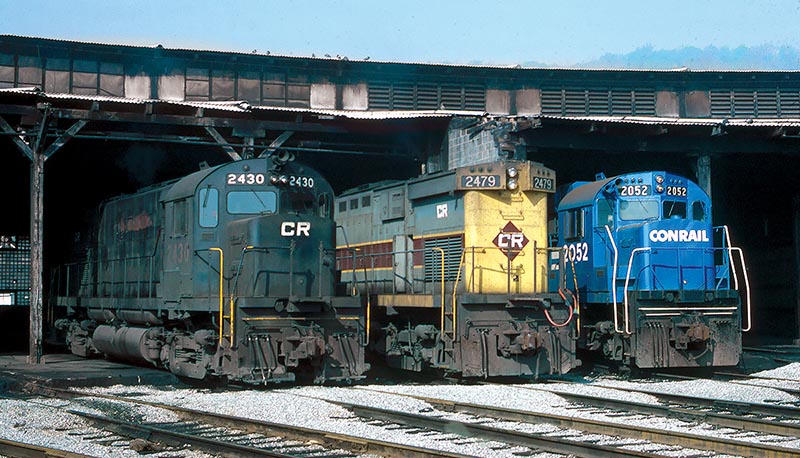
ABOVE: Conrail assigned its fleet of big Alco power to Mingo Junction, Ohio, to handle the heavy coal drags in the region. A visit in April 1977 shows former Penn Central and Erie Lackawanna units stabled with a freshly painted Conrail unit. They would be retired by the end of 1979. —G.E. Lloyd photo, Mike Stellpflug collection
The Rainbow Era
The underlying theme of Conrail’s Rainbow Era was the large variety of equipment on the roster, inherited from the legacy carriers, that included just about one of every example of modern diesel from EMD, Alco, GE, and even Baldwin. Despite new purchases arriving and existing equipment having its “deferred maintenance” being addressed, Conrail was still lacking enough available motive power so it turned to many other roads and leasing companies to borrow whatever it could to fill the gaps.
All manner of locomotives from Conrail’s predecessor railroads were common across the system. While some patterns definitely existed (like the former Reading MP15DCs being used on former Reading Company lines), research proves that they were often broken.
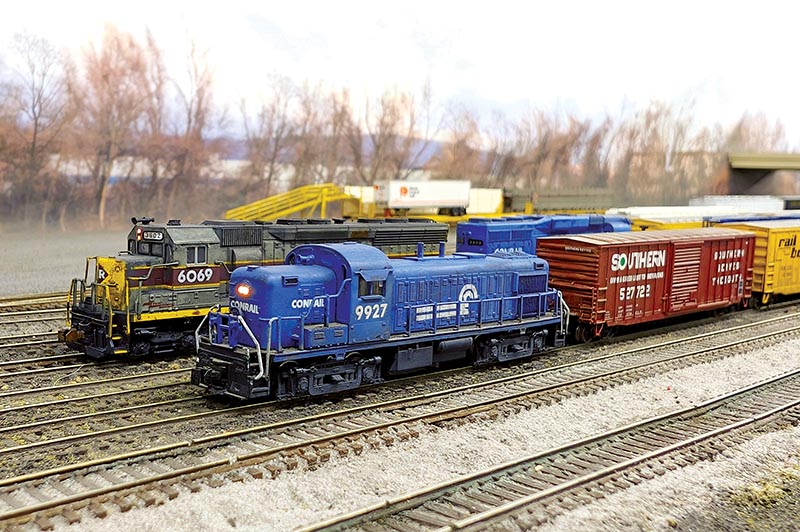
ABOVE: Short on serviceable power in the 1970s, Conrail continued PC’s program to remotor Alco RS-3s with EMD prime movers. SD45s were stalwarts of early Conrail main line trains, like this patched former Erie Lackawanna unit. —Ed Kapuscinski photo
Similarly, rolling stock was a mix of that of former owners. Conrail began repairing and repainting equipment relatively quickly; but after a short period of oddball paint jobs (like PC green boxcars with proper Conrail lettering) settled on the “Big Wheel” scheme (with large can openers) in 1976 and then the “Standard” schemes in 1978. Cars wearing their original owner’s paint, with or without Conrail patches, were still very common all through this era.
Cabooses were still in widespread use during the Rainbow Era. Unlike locomotives and cars that were frequently patched with Conrail lettering, cabooses did not commonly receive this treatment. As a result of new regulations and union agreements, the railroad embarked on a mass modernization effort for its caboose fleet. Inherited cabooses were updated with modern window glazing or some windows covered over with steel; roller-bearing Barber-Bettendorf caboose trucks were also installed.
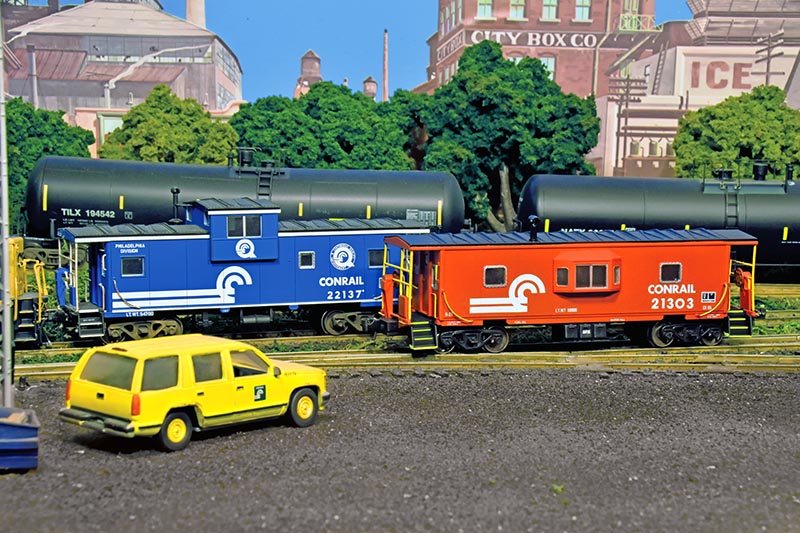
ABOVE: Some newer cabooses were retained for local operations. NS painted three cabooses solid red with full Conrail markings in 2001. Some newer ex-Reading wide-vision cabooses were also kept, like 22137. —Matt Snell photo
Conrail’s caboose fleet could be found in three different roles: “assigned” cars used in yard or local service, road cars equipped for through freights, and MOW cars (painted gray). Some of Conrail’s oldest in-use equipment was a number of cabooses that received “R” markings after their road numbers indicating that they were in “restricted” service and not to be used ahead of helpers.
Not all of Conrail’s equipment of this era was secondhand. Starting with its visit to GE’s “bargain bin” for some undelivered U36Bs (originally ordered by AutoTrain Corp. to Seaboard Coast Line specs), new power purchases also included many of the locomotives that would later become synonymous with Conrail: EMD GP15-1s, GP38-2s, GP40-2s, and SD40-2s. Additional orders were placed with General Electric for more U23Bs and then its successor B23-7s. This era also included Conrail’s only purchase of new cabooses: the N-21 class bay-window design from FGE. The Alco era also came to an end, with most remaining active units being stricken from the roster by the end of 1979…
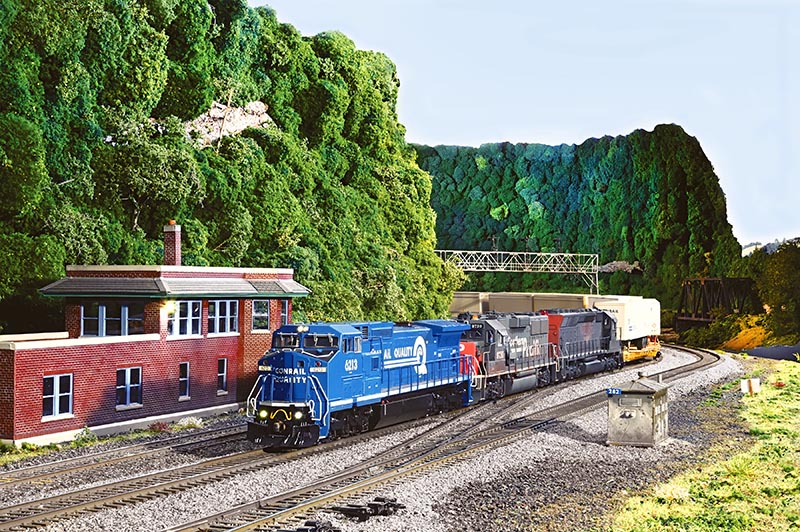
ABOVE: Train TV-79 is a high-priority westbound trailer train that routinely gets Southern Pacific run-through power. A new Conrail C40-8W leads a freshly repainted SP GP60 and a worn SD45 passing CP 282 on Dave Abeles’ HO scale Onondaga Cutoff. —Dave Abeles photo
