
 “How would you like to be part of our operations weekend?” The question came from my division superintendent as he was helping me build a power distribution panel for my layout. Construction of my proto-freelanced Port Morris Branch of the Harlem Division had only started two years earlier, but I was making good progress on my point-to-point main line.
“Uhh, sure!” I said with all the confidence I could muster as I looked around the room at the unfinished projects, plus a main line and second yard still to complete.
“Great. The date is in mid-September.”
It was the end of July. The pressure was on!
My HO scale Port Morris Branch is a compact urban switching railroad inspired by my memories of riding Harlem Line trains with my dad to visit his workshop in New York City. Set loosely in the late 1970s and early 1980s, operations combine Conrail local freights with Metro-North commuter trains running between a freelanced terminal inspired by New York Central’s former Port Morris Yard in The Bronx and a scaled-down Putnam Jct. Yard in Brewster, some 50 miles to the north. In between I’ve strung together several scenes of railroading I remembered from my youth.
I am admittedly not an operations fanatic, and sometimes I’d rather “railfan” the action than pick up a throttle. Still, I’ve helped plan operating sessions and had a taste of the real thing as a volunteer conductor at the local railroad museum. From the beginning, I wanted my layout to be fun to operate alone, but interesting enough to entertain a few visitors.
Nothing like a deadline to get you motivated! I quickly completed the yard at Brewster, finished an abandoned canal scene, and installed a drawbridge so I could complete the east end yard lead and customer siding at Bayview.
With those projects finished, it was time to put together an operating plan. Since my railroad is relatively small, I kept things simple. A typical day begins with the Oak Point Transfer arriving at Port Morris to exchange inbound and outbound cars. The yard crew then builds a local to serve Melrose Park and Kingsbridge, and then switches nearby industries.
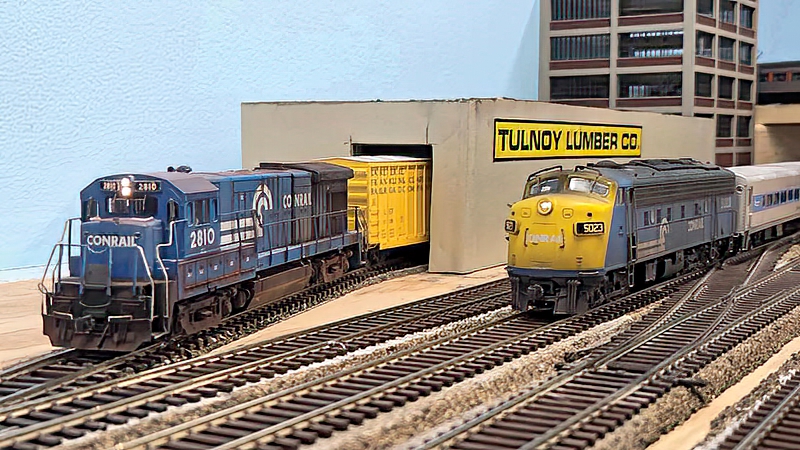
ABOVE: Conrail B230-7 2810 is in the clear at Tulnoy Lumber while a Harlem Line commuter train passes by on the main line.
Meanwhile, two commuter trains operate on opposing schedules over the single-track main line, alternating departures throughout the session. That steady back-and-forth keeps things moving and forces the local freight crew to stay alert — and, more importantly, stay out of the way of the passenger trains.
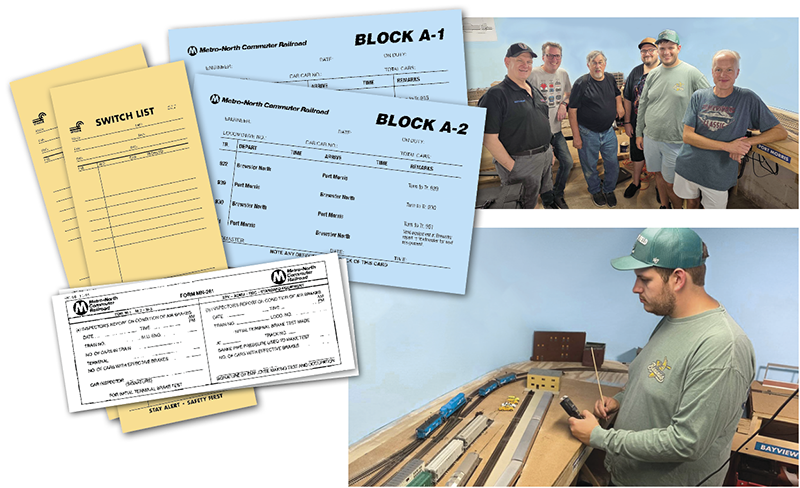
With the big event just a few weeks away, I hosted a shakedown run in mid-August. I spent several evenings writing job descriptions, creating switch list and time card forms, inspecting cars, programming locomotives, and adding more throttles and plug-in panels. I labeled stations, control points, and customers, and printed maps of the major areas to help operators understand where they were and how the tracks were assigned. Most importantly, I cleaned the layout room and stocked up on snacks and soft drinks! As I was backing the Oak Point Transfer into staging, the first guests arrived. Show time!
Five operators came down to test the system. After a brief tour and explanation of operations, I let everyone choose their jobs. Experience ranged from veteran operators to complete beginners. Soon the first commuter trains were departing their terminals, the Oak Point Transfer was coming out of staging, and the railroad had come to life for the first time.
As host, I didn’t run any trains. Instead, I acted as superintendent, answering questions and troubleshooting problems. Before the session even began, I had to replace a faulty turnout that was causing a short. Later, an operator discovered a dead track in Bayview, so I broke out the soldering iron and installed a feeder on the fly. It was all part of the fun.
Two hours later, we debriefed on what worked and what didn’t. The Brewster yardmaster needed more to do, a problem that will be solved once more locomotives are added to the roster. A lull in the action could also be filled with work extras and other trains as more rolling stock comes online. “Rescue” moves and other disruptions to the commuter schedule would also add operational interest. After running some trains it became clear Brewster needed another crossover. But the important parts worked: the baseline schedule held together, the paperwork did its job, and everyone had fun. I learned a few things that will make the railroad better next time.
If you’re like me and sometimes hesitant to get into operations, give it a try. You’ll find it opens up a whole other avenue of enjoyment in this hobby.
—Otto M. Vondrak
