

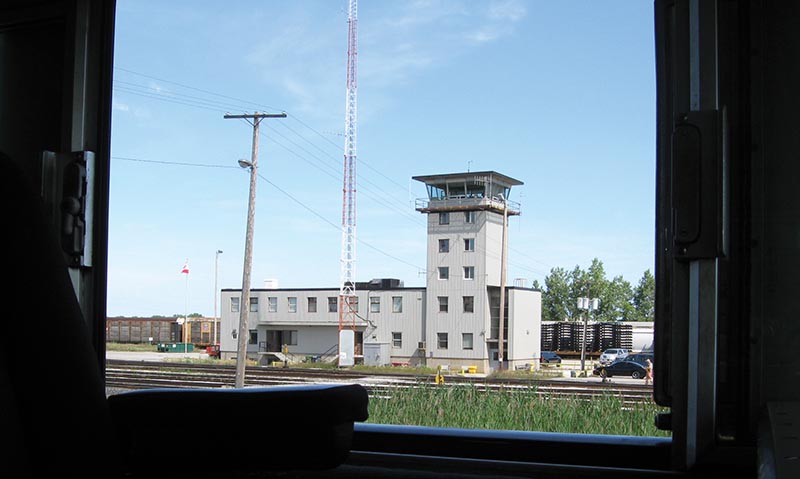
 Yard office towers can be found in many yards across the country. They are places where the yardmaster and other employees can easily watch the comings and goings of a busy rail yard. During my career with Canadian National, I spent plenty of time in yard offices, some of which would make outstanding models on a layout.
The CN office at Fort Talbotville, Ont., where the railroad and Norfolk Southern served the Ford motor plant, was built of concrete block, a common material for these structures, although I’ve also seen wood-sided examples. On the main floor were a crew lunchroom, train crew locker room, washroom with showers, storage space for computer paper and supplies, and a small room where crews booked on duty. The booking-in room contained the area bulletin books and train register, which was used for crew sign-ins and on- and off-duty times. No train orders were required there, so there was no operator.
At Talbotville, two crews worked each of the three shifts, so there was plenty of switching activity. Upstairs, the space was divided into two rooms. One was an office for the trainmaster. The other was used by the clerks and it overlooked the yard. It contained desks, printers, monitors, and computer keyboards, replacing the earlier card-file system, although many locations still retain the old holders once used to keep everything in order.
The clerks prepared lists for crews switching the Ford plant and car-loading ramp, as well as transfers taken to Southwold for Norfolk Southern. From the windows, they could make sure cars were in order as tracks were pulled or transfers arrived and departed. They then printed a journal or switch list for the train crew. Normally, the conductor came upstairs to collect the paperwork, but the car-control clerk could also drop it out the window to speed things along.
Ford is now gone and Talbotville Yard has closed, but a short line has taken over the location for car storage. It’s possible the old yard office may yet find a new life.
The CN yard tower at Sarnia, Ont., stood in the middle of C Yard, between the arrival tracks and outbound yard. It was a much larger structure than the office at Talbotville. Sarnia was a major terminal, linking Canada and the United States through the tunnel beneath the St. Clair River.
The building was typical of many yard offices, but with a tower rising from one end. The top floor was mostly windows, giving the yardmaster a commanding view of the tracks below. Reaching it meant a long climb up six flights of stairs. The new Walthers Modern Yard Tower kit (no. 933-3557) would be a good starting point to model a facility like this.
The west-end run I used to work terminated on Grand Trunk Western in East Detroit, where another yard office tower divided the yard. One side, near the main line, handled arrivals and departures, while the other held cars destined for the nearby General Motors plant. The building was arranged much like the tower at Sarnia.
In New England, Boston & Maine maintained a two-story wooden yard office at White River Junction, Vt., complete with a train-order signal. It stood midway down the yard, with the main line on one side and the yard tracks on the other. Central Vermont had a smaller single-story wooden office at Italy Yard near St. Albans. Built on a high foundation atop a rise, it gave the yardmaster a good view from a bay window at the south end. A covered ramp connected the office with the yard tracks.
I have also seen brick yard offices, with and without towers, on Maine Central at places such as Waterville, Portland, and Bangor, Maine. Monster Modelworks offers a compressed model of the Bangor yard tower.
Today, a tower overlooking the yard is no longer necessary at most locations. Before I retired, many places I worked used pole-mounted cameras, often combined with overhead lighting, allowing clerks and yardmasters to monitor passing cars remotely. In some cases, the yardmaster is no longer even located in the same town. Railcar scanners and computerized tracking systems now keep tabs on what is moving through the yard, with technology replacing much of the work once performed by car-control clerks.
Modeling a yard office or tower can add another distinctive structure to your layout, one that once played an important role in railroad operations.
—George Dutka
