

 by Eric Groody/photos by the author
Like many model railroaders, I got my start around age nine with my first HO scale train set. I later built a larger HO layout during my early teens and continued dabbling in the hobby on and off for years. In the early 1990s, I became more serious about model railroading and switched to N scale, which allowed me to build a small portable layout in the limited space I had available. I have remained in N scale ever since. Although I built a couple of small layouts, I eventually wanted more in the way of operation and switching.
In 2005, I began planning and building a moderate-sized N scale shelf layout based on the prototype Housatonic Railroad, a freight-oriented short line based in Canaan, Conn., that interchanges with CSX in Pittsfield, Mass. My primary goal was to create recognizable scenes based on actual Housatonic customers, modeled at a more plausible and realistic size than is often possible on a model railroad. I wanted to capture recognizable structures, track arrangements, and prototypical car capacities so operations would feel as accurate as possible.
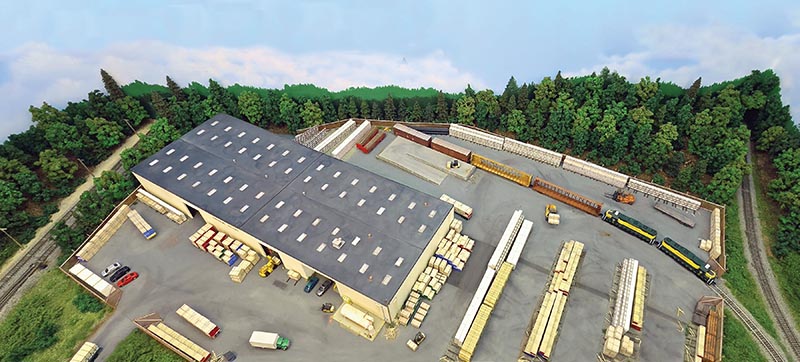
I have made some compromises, but I am pleased with the larger rail-served industrial scenes, which appear substantial enough to justify their rail traffic to the average viewer or guest operator. The Shepaug Reload and Distribution Center is a good example of this approach.
I chose to model the Shepaug Reload & Distribution Center — known by Housatonic Railroad crews and local residents simply as “Shepaug Reload” — because it generates a significant amount of rail traffic and offers plenty of operational interest. Its unusual arrangement meant the entire scene had to be scratchbuilt, since no commercial N scale kits accurately represented the main structure, loading dock, centerbeam unloading area, and lumber storage facilities.
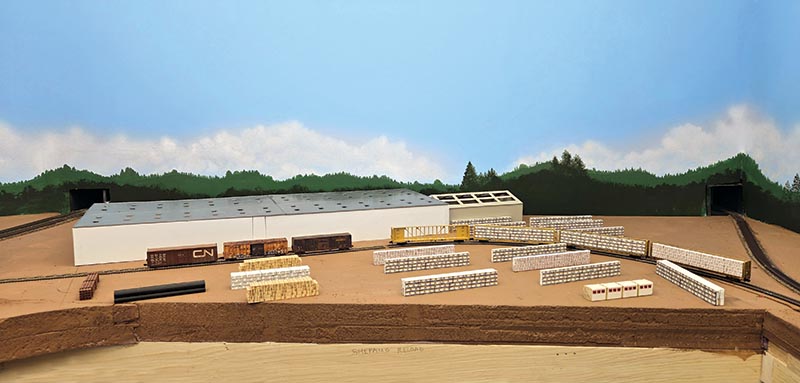
ABOVE: After the final structure’s dimensions were established, a full-size mock-up was built to plan its placement. The track, initially positioned in front of the building, was later moved behind it for a more prototypical layout and a gentler curve into the yard.
Shepaug Reload
The prototype Shepaug Reload & Distribution Center is located in the Hawleyville section of Newtown, Conn. It opened in 2001 and is operated by Housatonic Railroad. The name “Shepaug” pays homage to the historic Shepaug, Litchfield & Northern Railroad, which began connecting Litchfield County with other rail lines through the junction at Hawleyville in the 1870s. New York, New Haven & Hartford Railroad later acquired the line and ultimately abandoned it in 1948. However, a short remnant of the historic right-of-way survives as the spur serving Shepaug Reload, branching from the former New Haven Maybrook Line.
The facility functions as a bulk rail-to-truck transfer, storage, and distribution terminal, primarily handling dimensional lumber, plywood, and other building materials. The site features loading docks designed specifically for boxcar unloading and direct rail-to-truck cross-docking. There is also significant open yard space for centerbeam unloading, where high-capacity forklifts handle heavy-duty lumber bundles and palletized materials. Storage includes outdoor areas for weather-resistant goods, and covered warehouse space for high-grade finished forest products and other lumber awaiting distribution to lumberyards, contractors, and home improvement centers throughout the region.
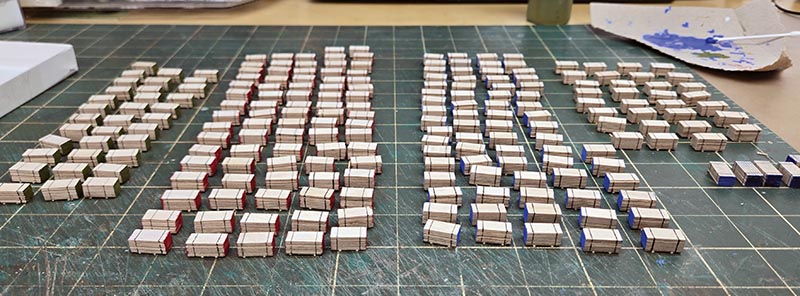
ABOVE: The scale plywood stacks were completed and the ends were painted to represent color coding for sheet thickness. Banding was applied, and scale 2×4 spacers were glued to the bottom of each stack to allow for air circulation and for the forklift tines to be able to get underneath each individual pile. In addition to plywood, dimensional lumber was represented by scribing the tops of each stack to represent scale-sized individual pieces of lumber.
Shepaug Reload is switched daily during the week. Train NX-10 brings in centerbeam cars loaded with bundled dimensional lumber, as well as boxcars carrying plywood, oriented strand board (OSB), and other weather-sensitive building materials. The prototype spur can accommodate at least two double-door boxcars at the loading dock, along with three or four centerbeam cars for dimensional lumber.
Research
I have extensively researched each of the customers served by Housatonic Railroad, and Shepaug Reload is no exception. I have taken numerous photographs from public areas and relied heavily on resources such as Google Earth to better understand the track arrangement and overall layout of each customer I am modeling. During research trips and field visits, I make it a point never to trespass on railroad or other private property.
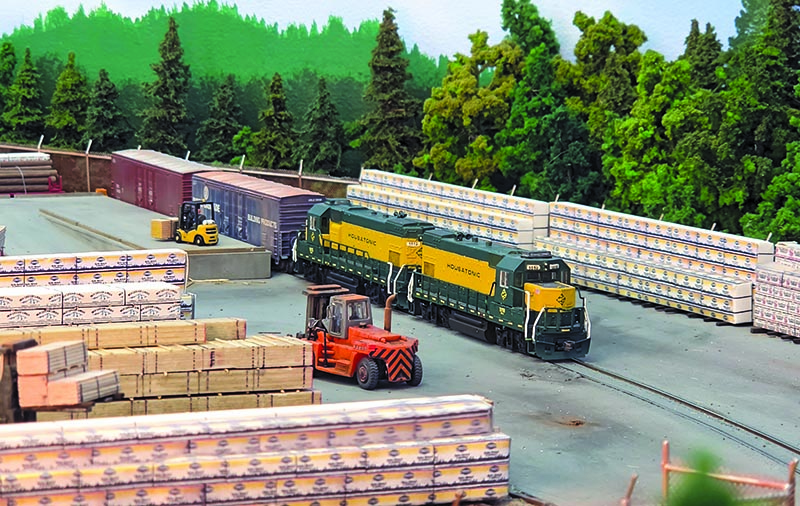
ABOVE: A view from the outdoor lumber yard toward the rail-unloading area at the Shepaug Reload & Distribution Center. Heavy-duty forklifts unload dimensional lumber from centerbeam cars delivered by Housatonic Railroad road job NX-10.
The N scale Shepaug Reload is part of a layout expansion I began in November 2025. The main shelf layout runs along the walls of a 13×21’ multi-use bonus and craft room on the second floor of our home. When the main layout was essentially complete in late 2025, I began Phase 2 by expanding into an adjoining 6×10’ walk-in closet. This required tunneling through the wall separating the two spaces and building shelf-style benchwork to match the elevation of the existing layout. Shepaug Reload occupies a shelf area 6’ wide, with the overall scene extending 2’ deep.
Throughout the layout, I use Atlas Code 55 flex track, along with Atlas Code 55 No. 7 and No. 10 turnouts. All turnouts are manually thrown. Once I was satisfied with the length of the spur serving Shepaug Reload, I mocked up the main warehouse and lumber storage areas using structures I had previously built, along with simple cardstock and foamcore stand-ins. Extensive use of mock-ups helps visualize the available space, building orientation, and relative size of each structure. After moving the mock-ups around and experimenting with different arrangements, I settled on the final track position as well as the size and design of the primary warehouse structure…
