
 by Seth Neumann/photos by Harry K. Wong
My HO scale Union Pacific Oakland Subdivision grew out of a desire to model the railroad I saw around me in the San Francisco Bay Area. The former Western Pacific route through Niles Canyon, Pleasanton, Warm Springs, and Milpitas offered an appealing mix of modern Union Pacific operations, local industries, commuter trains, and even the neighboring Niles Canyon Railway. As I spent more time operating on other layouts, I became less interested in simply reproducing scenes and more interested in creating a railroad where the jobs, traffic, and operating patterns made sense.
I started planning the Oakland Sub in 1998. I enjoy switching and yard operations and wanted a layout that would provide a satisfying challenge. Switching jobs are often in high demand at operating sessions, so I wanted to model a prototype with plenty of opportunities for local work while also recreating what I saw on the rails around the Bay Area. While modern railroading might seem to be all about double-stack intermodal traffic and unit trains, there are still jobs that work local industries if you know where to look.
That led me toward a prototype-based approach, although not one that follows history down to the last detail. I wanted the industries to appear in roughly the correct locations and sequence along the railroad, and I tried to preserve the way the territory would look from the familiar “railfan view.” At the same time, I was willing to compress distances, relocate an industry slightly, or extend its rail service beyond the actual date if doing so produced better operations while still preserving the character of the East Bay in 1999.
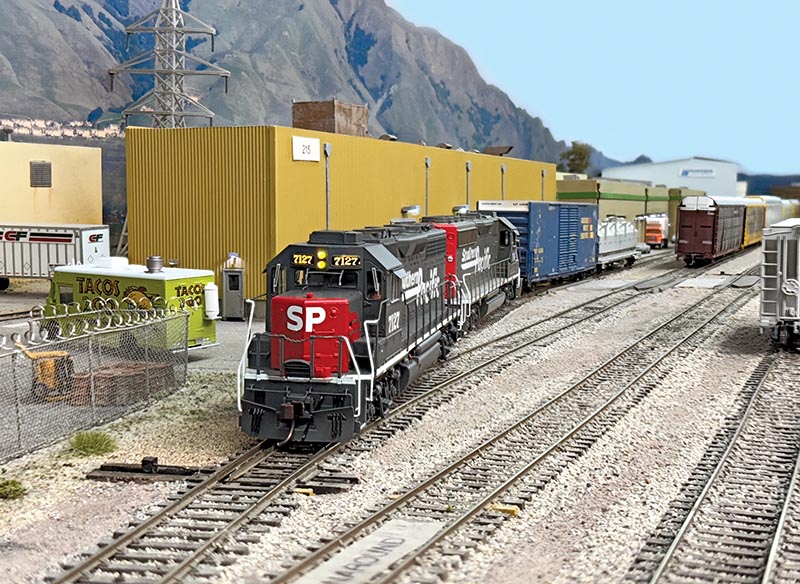
ABOVE: Back at Milpitas Yard, LRV54 puts away its pickups. These cars are headed for “4 Track,” where outbound traffic for Roseville via the MSJRV accumulates.
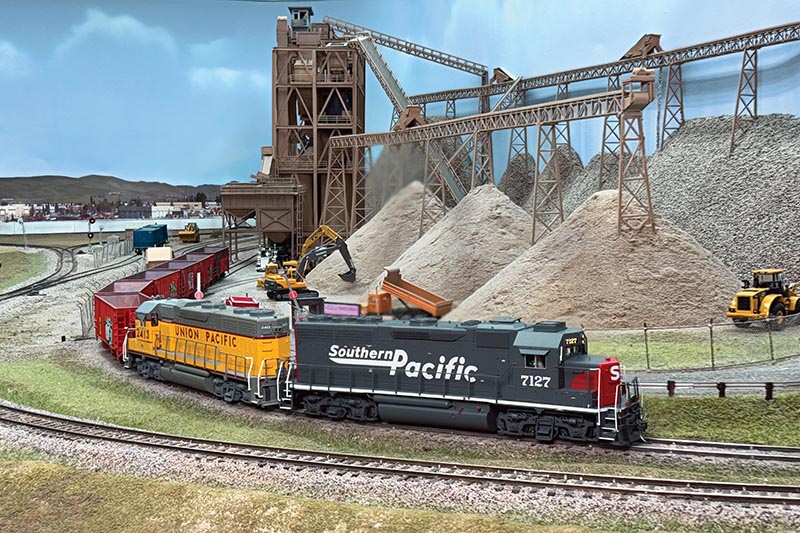
Rather than filling the layout with a large number of small industries, I preferred fewer, larger customers capable of generating substantial traffic and meaningful switching. The focus of the layout became the GM/Toyota joint venture New United Motor Manufacturing Inc. (NUMMI). In 1999, the automotive assembly plant was operating two shifts, six days a week, building Toyota Tacoma pickup trucks and Chevrolet Prizms, which were rebadged Toyota Corollas. Kaiser Sand & Gravel, Milpitas Yard, Snoboy, and a collection of smaller customers provide additional traffic.
The NUMMI plant, Warm Springs Yard, and Milpitas Yard a few miles to the south supported a variety of trains. Two locals were based at Milpitas: the NUMMI job, which served the auto plant on a “just-in-time” schedule, and LRV54 (Local-Roseville Area). The LRV54 worked north toward Pleasanton, serving gravel pits and other customers. Two other locals called at Milpitas daily: the Mission Bay Local (MBL), which originated in South San Francisco and arrived early in the morning with traffic from the San Francisco Peninsula, and the BNSF Trackage Rights Local, operating under concessions granted as part of the 1996 Southern Pacific/Union Pacific merger.
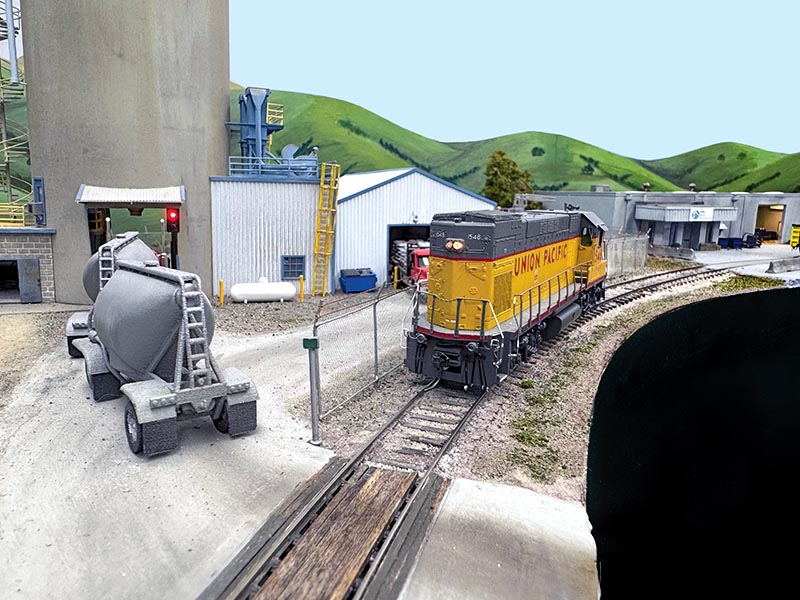
ABOVE: UP GP15-1 1548 has just set out an empty gondola for Sims Metals at Niles and is easing past the Lehigh Cement reload. Both structures were built by Earl Girbovan, MMR.
To round things out, we also model Altamont Commuter Express (ACE) trains, Niles Canyon Railway (NCRY) excursions and equipment transfers, and two industries with their own in-plant switchers.
The result is a railroad built around locals, industry jobs, transfers, commuter traffic, and the interaction between them. For me, operations means modeling the jobs of the railroad, and every design decision was made with the goal of giving the crews something satisfying to do.
LRV54 Pleasanton Turn
LRV54 was one of the “signature trains” operating out of Milpitas in 1999. It ran almost every day during daylight hours and could often be seen dodging the Altamont Commuter Express (ACE) at Hearst Siding while handling a cut of aging rock hoppers along with general freight. Power was typically a mix of Union Pacific, former Southern Pacific, and Rio Grande four-axle units.
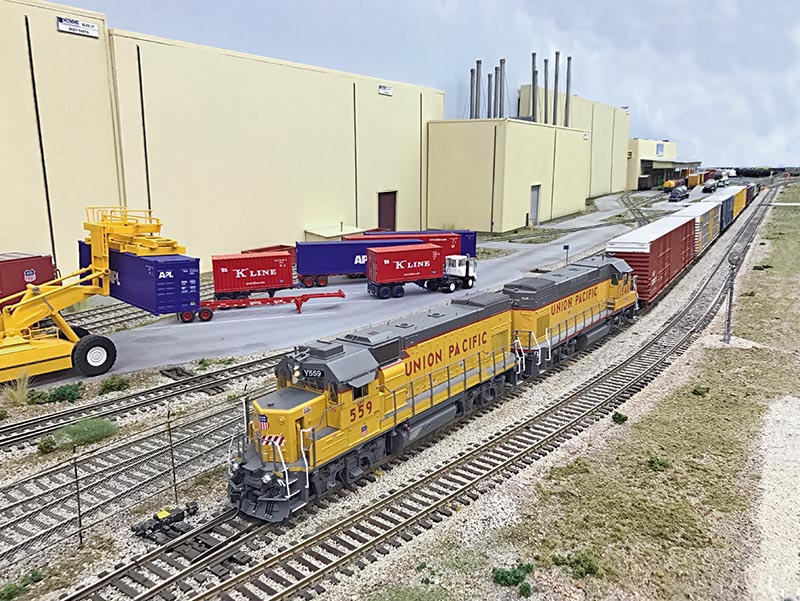
ABOVE: A pair of GP15s brings the first NUMMI “pull” into the plant with body parts, drivetrain components, and steel. The crew will work the trailing-point switches, run around the train, handle the facing-point work, sort the consist, and return to Milpitas Yard for another pull.
Kaiser Sand & Gravel represents the Pleasanton-area gravel traffic. Keeping Richert Lumber, Villa Armando Winery, and Pacific Brick Company (PaBriCo) rail-served into the new millennium helps fill out the train and provides additional switching along the route.
The 54 Local is made up in Milpitas Yard and works north, switching trailing-point industries along the way. It turns on the wye at Radum, then returns to Milpitas while continuing to work trailing-point spurs. The crew blocks the train in station order to eliminate the need to run around cars at the industries.
The LRV54’s hopper cut has already been delivered by the morning Mission Bay Local and is waiting on the arrival/departure track at Milpitas when the 54 crew goes on duty. The crew blocks its train while waiting for ACE Train 5 to pass. Once the ACE is clear, the dispatcher gives LRV54 the signal to proceed north toward Niles, where the switching begins…
