
 Living within earshot (and bicycle range) of Canadian National’s Oakville Subdivision in the mid-1970s, I had a front-row seat to as diverse a stretch of busy main line railway as a budding teenage railfan could hope for. Attending a high school that faced the tracks made it even easier to keep an eye on the passing parade.
Freight traffic included CN; Canadian Pacific; Toronto, Hamilton & Buffalo; and Penn Central, later Conrail. GO Transit, then still a young commuter operation, added variety by testing borrowed CP and Chicago & North Western bi-level equipment and using Ontario Northland intercity coaches to meet demand.
For me, though, the intercity passenger trains were the real stars. CN fielded long conventional consists behind GMD and MLW cab units, boosters, and road switchers; aluminum-bodied Tempo trains led by bright orange, head-end-power-equipped RS-18M locomotives; and plenty of Budd Rail Diesel Cars, including No. 6110, the original demonstrator built in 1949. Blue-and-yellow VIA Rail paint began appearing in early 1976, a hint of what was to come. CP Rail also contributed a daily Toronto–Buffalo Rail Diesel Car round trip, jointly operated with Toronto, Hamilton & Buffalo over CN trackage rights.
That much variety was a lot for a young railfan to absorb, but the real standout for me was a low-slung silver-and-orange locomotive and coach I first saw at Oakville station in early 1975. Developed by MLW/Bombardier, Alcan, and Dofasco, with support from the Canadian government, the LRC (“Light, Rapid, Comfortable”) was intended to modernize passenger service not only in the Ontario–Quebec corridor, but also in Alberta, the Maritimes, and elsewhere.
As part of the testing program, demonstrators JV1, the locomotive, and JV2, the coach, had been leading CN passenger trains west of Toronto for several months. I knew about the LRC but had seen it only in newspaper photos. In that pre-internet world, coming face-to-face with the real thing felt like meeting the future.
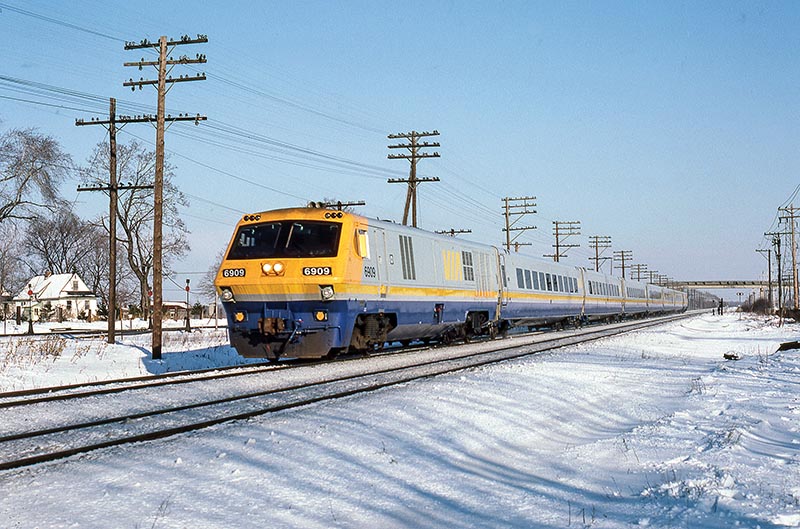
Amtrak evaluated the LRC in 1981 but did not extend the demonstration agreement. VIA’s first LRC trains entered service that October, with the fleet fully deployed by 1982, though only in the Corridor. Apart from former Amtrak cars later used in VIA’s Toronto–Chicago service, that is where the equipment spent its entire career.
Between 1980 and 1985, VIA acquired 31 Alco 251-powered locomotives and 100 LRC cars. Their arrival signaled the coming, though not immediate, retirement of the vintage cab and booster units, Tempo locomotives, and blue-and-yellow passenger cars that had defined the end of CN’s Corridor era and the beginning of VIA’s. Hopes for additional domestic and international orders went unfulfilled.
On my first trip in an LRC coach in the mid-1980s, the train’s acceleration on CN’s Kingston Subdivision pressed me firmly into the seat and briefly recalled an airliner’s takeoff roll. The resemblance ended there. The large tinted windows and generous seat spacing made it unmistakably a train, but unlike any I had experienced. The LRC was indeed Light, Rapid, and Comfortable, just as advertised.
For less than two years, VIA’s new LRC fleet shared the Kingston Sub with the aging United Aircraft Turbo Trains in a brief contest between successor and predecessor. When the final Turbos were retired in October 1982, the LRCs inherited the role of Corridor speedsters. The LRC-equipped Metropolis remains the fastest scheduled Toronto–Montreal train, covering the 335-mile route in 3 hours 59 minutes, a time made possible by the locomotives’ rapid acceleration and, when functioning properly, the cars’ active-tilt system.
More than 50 years after my first encounter with JV1 and JV2 at Oakville, VIA’s LRC locomotives have long since disappeared from active service. The remaining LRC cars, their troublesome banking systems removed and their aluminum bodies showing their age, are now nearing retirement as new Siemens trainsets wait in the wings.
The LRC fleet had its share of early problems, but went on to provide decades of fast, reliable, and comfortable service in VIA’s Corridor. There is still a little time left to experience the final chapter of the LRC era, whether from trackside or onboard. If you have been thinking about making one last trip, or perhaps your first, now is the time. I think you will be glad you did. —Kevin J. Holland
