

 Dorothy Newell Deane’s book Sierra Railway (Howell-North, 1960) was my inspiration and incentive to create a prototype-based layout. My interest in the hobby shifted dramatically when I discovered that narrow gauge railroads were not the only prototype railroads that were small enough to model — Dean’s book had enough plans of trackwork and prototype scenes that I could hope to recreate some of them, then refer to a specific protype to verify that the realism of the layout was a reasonable replica. I started to create my first prototype-based layout, only advancing far enough to the plan for a 12×72-inch shelf layout (because that was all the space I had) with just the freight station and nearby tracks at Sonora, Calif.
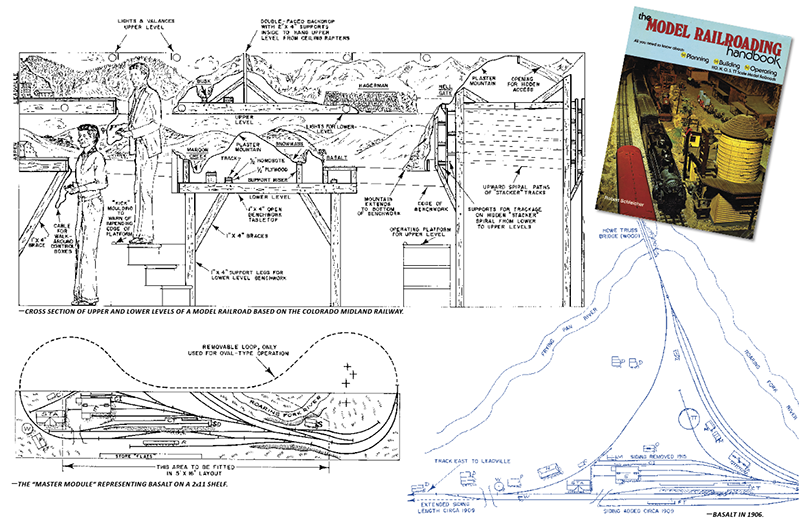
My interest in model railroading was buried in the excitement of trail-racing motorcycles, restoring an MG TC open two-seat roadster, and starting a family and building a career in international marketing for a couple of decades. My current career as an author began in the mid-1970s with magazine articles and books that included the publication of The Model Railroading Handbook (Chilton, 1975). I had discovered Morris Cafky’s Colorado Midland (Rocky Mountain Railroad Club, 1974) book and used that to help research a chapter in the MRRH. Incorporated in 1883, the Colorado Midland Railway was the first standard-gauge railroad built over the Continental Divide in Colorado. Running from Colorado Springs to Leadville, Aspen, and Grand Junction, it was an engineering marvel but struggled with steep grades and financial debt, leading to its permanent closure in 1918.
With so much character, the Colorado Midland provided the perfect template for designing and building a double-deck two-car-garage size HO replica of the railroad’s most spectacular portion between Leadville and Basalt, up the Aspen branch to the mines. Another chapter of the MRRH described how to build a 5×16-foot figure-8 layout with Basalt on the visible upper straight portion of the “8” and rather complex staging functions on the hidden lower diagonal. That layout was titled “The Master Module.”
When I was creating Model Railroading magazine in the 1980s and 1990s, about a dozen issues included all the steps to build, scenic and operate a 2×8-foot module that was the centerpiece of a much-modified 6×21-foot version of the “Master Module” figure-8 layout from The Model Railroading Handbook that was “unwrapped” into a single-level dog bone-style layout with turnback loops at each end and staging across the back. It reached the benchwork stage with the 2×8 portion complete and scenicked.
The basic track plan was a replica of the “Timesaver” layout that the late John Allen had developed and that was used for switching contests at NMRA conventions. My layout featured removable structure bases I called “scene sites” so the time period could be changed from the 1980s, to the 60s, to the 50s or to 1907. The structures in the 1907 version were replicas of those at Thomasville, just east of Basalt, on the Colorado Midland, with the station, three section houses, the cattle pen and empty building sites replacing a modern grain elevator, oil depot and a tilt-up warehouse of the module’s more modern versions.
About six years ago I bought a basement (that came with a “free” house!) with a “perfect” space for a 26×14-foot J-shaped shelf layout. That space is much too cramped for an ambitious garage-filled layout, so I opted to recreate just one area of the Colorado Midland — Basalt — and an 8-foot portion of the Frying Pan Valley east of town and a 4-foot long version of Thomasville (with the structures from the 2×8-foot module) that was a few more miles up the valley. That fills about a third of the layout space; the remaining two-thirds depict the northern Colorado prairies, with a much-modified Fort Collins (the 2×8-foot “Timesaver” layout with about five of Fort Collins’ “signature” 1953 era structures). I have a scenario for my railroad that makes the connections of Basalt and Fort Collins and the Colorado Midland and the Colorado & Southern credible enough so I can operate the Colorado Midland in 1907 or the Colorado & Southern in 1953.
It’s been a long road to get to this point, but I’m enjoying sharing my progress with you along the way.
—Robert Schleicher
