

 One day, way back when I was just getting going in this great hobby, I brought home yet another boxcar. When she saw it my wife asked, “How many boxcars do you need?” Good question. And I really didn’t have a good answer. All I knew was I needed another one, right? I had all kinds of boxcars in a variety of road names and in all colors. Variety was the spice of life at that point in my collecting and modeling. But the one I just acquired had struck my fancy for one reason or another.
Now, decades later, having built and dismantled a large 25×45 ft. layout which had lots of boxcars — and every other type of car as well — I now have a 12×25 ft. S (1:64) scale layout that is basically a large switching layout (see “Buffalo Creek & Gauley: Summer of ‘64” in the November 2022 RMC). It is point-to-point with no provision for continuous running. Four-car consists are the norm. I use a written switch list generated by a simple card draw system for car routing (see “Car Routing for Smaller Layouts,” February 2025 RMC). On the switch list, I indicate only the car number, not the road name, the reason for which will be clear as you read on.
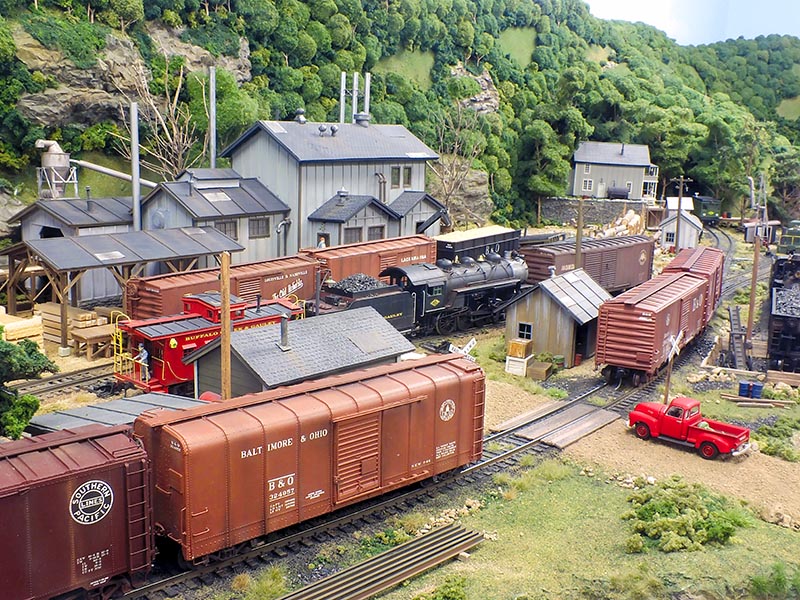
Can I answer the question of how many boxcars I need now? Well, I’m still not sure I can. But I have learned one thing for certain about my boxcars. I like them all the same color — variations of brown.
It’s well established that the fun of operating on a small layout is the thinking that is required to plan and execute the needed switching maneuvers. That’s certainly what I’m enjoying about my layout. While passively watching trains run is fun, it’s actively using my head to decide what needs to be done and how to do it that I find so enjoyable. Now, while one doesn’t want to make planning and executing switching maneuvers unnecessarily, and therefore un-prototypically, complicated, there’s no value in making it as simple as possible as that diminishes the thinking element.
In 1963–64, the years I model, the nine-mile-long Buffalo Creek & Gauley (BC&G) served just one industry: a sawmill at Swandale, W.Va. Cut lumber moved out in boxcars and bulkhead flats, while wood chips were hauled away in chip hoppers. The few color photos I have seen from that period show that boxcars predominated, and they were all brown. No fancy paint schemes here in the hills of West Virginia in the mid-1960s.
When I first began operating on my new layout, I still had a number of “non-brown” boxcars in the rotation. What I discovered was that, when reading switch lists, I would think “green boxcar” or “gray boxcar” instead of “No. 2122” or “No. 546799.” Those non-brown cars became memorable simply because they stood out. Over time, I removed them from the rotation and replaced them with brown boxcars, which are, by design, much less memorable.
An all-brown boxcar fleet means I actually have to read the car numbers — sometimes with considerable effort in a crowded yard — just as the prototype crews would have done, because it is the only reliable way to distinguish one car from another. That makes operations a little more challenging, requires a little more concentration, and creates a more engaging experience. Just what the doctor ordered! As a bonus, the layout also looks more like the color photos of the prototype.
Modeling in S scale helps the cause. The road numbers are easier to read than they would be in smaller scales. Even so, there are still times when extra effort is needed to identify a car. At Dundon, the Baltimore & Ohio interchange extends under a highway bridge, putting cars in the shadows and making the numbers harder to read. At Swandale, the big company store stands between its siding and the edge of the layout. There, the only visible number is the one high on the end of the car. In situations like that, the larger size of S scale really pays off, as those end numbers remain quite readable.
Now, when I look at a printed switch list, I may recognize a car number, but I have enough brown boxcars in rotation that I cannot always remember the road name or even the exact shade of brown. So I have to go hunt for it at the sawmill or in the consist the same way BC&G crews did — by reading the car numbers.
I think, at last, after all these years, I can finally answer the question of how many brown boxcars I need: enough that I can’t remember which road number belongs to which car.
—Brooks Stover, MMR
