

 How often do you tell someone about your hobby of model railroading, and they answer with something like, “How cute, you play with toy trains!” They’re not doing it on purpose, but it still stings a little.
Instead of focusing on trains, what if we said, “I am a historian”? Modeling makes us curious, and curiosity leads us to research. We often become quite conversant in — and sometimes expert on — the history of the railroads we model, the industries they served, and the places they traveled through. Like many modelers, I became quite interested in Cass, W.Va., on the Chesapeake & Ohio Greenbrier Subdivision. I started with one book, then read several more. I took trips to the area and developed a deeper understanding of what I had learned. A visit to the C&O Historical Society archives uncovered new information that led to two articles for its historical magazine about the abandonment of the Greenbrier Sub.
Or what if we said, “I am a craftsperson”? My first layout visit, back in the 1990s, was to the late Jim Vail’s superb Glenwood & Black Creek Railroad, and I was in awe of its craftsmanship. The structures and rolling stock, in particular, were highly detailed and beautifully built. My first attempt at a craftsman kit was humbling. Over time, however, my skills improved as I worked to build more prototype-accurate models. While I’m not as skilled as Jim Vail or many other modelers, I did earn the NMRA Master Builder — Structures certificate. Interestingly, I’ve found that reminding myself I want to be a craftsperson improves the quality of my work. I slow down and focus on achieving the best results I can.
We could tell our friends, “I am an author and photographer!” Ours is a hobby that encourages amateurs to publish their work in magazines and other outlets. Every month, we read well-written articles that inspire and inform our own modeling projects. We also see photos so well-composed, photographed, and edited that they make models look strikingly prototypical and realistic.
Perhaps we could say, “I am an artist!” Setting aside, for the moment, the question of what art is — and whether a model railroad can be art — we certainly face many of the same challenges artists do. Composition is critical to a successful scene. Choosing the right elements and arranging them well creates focal points, negative space, and a scene that simply feels right. Color choice is equally important, and the best option is often not the most obvious one. Lance Mindheim has explored the idea of modeling as an immersive experience in many of his works.
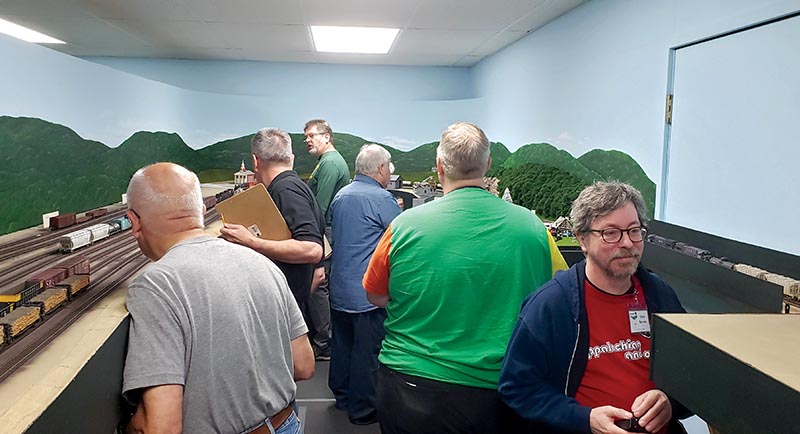
We might also say, “I am an event coordinator!” That may be a stretch for me, but not for the many volunteers who plan and organize model railroad conventions, operating sessions, and other events involving dozens, if not hundreds, of people. I’ve been fortunate to host approximately 75 operating sessions on my own layout. Organizing one goes well beyond the railroad itself to ensure guests have an enjoyable experience before, during, and after the session.
Yet another possibility would be, “I am a project manager!” Building a model railroad can be a multi-year effort with many interdependencies. It requires clear goals, careful allocation of resources, planning, tracking progress, and adjusting as needed. For those working in clubs or building a home layout with friends, managing people is part of the job as well. Even those working alone may need to outsource parts of the project. In my case, that meant hiring contractors for room preparation and working with family and friends to build the benchwork and backdrop. A key part of project management is sustaining progress in a way that keeps everyone — including yourself — motivated.
There are many ways we can frame the pursuit of our hobby to help our friends better understand it. Before this discussion, had you stopped to consider all the skills you’ve built up over the years? Each takes time and energy to develop, but along the way you gain new knowledge, new abilities, and maybe even a few new friendships. Perhaps our non-model-railroad friends are right, and at times we really are just “playing with trains” — and that’s perfectly fine. But we know our hobby also gives us the opportunity to become historians, craftspersons, artists, authors, photographers, event coordinators, project managers, and so much more.
What a great hobby!
—Joe Green
