
 Story and Photos by Bryan Steckler
When Amtrak assumed operation of the nation’s passenger rail system in 1971, it inherited the high-speed Metroliner that had begun under Penn Central in 1969. This service used stainless steel electric multiple-unit cars built by Budd. The trains proved immensely popular in the densely populated corridor between New York and Washington, D.C. By the mid-1980s the Budd-built EMUs were replaced with conventional locomotive-hauled trains branded as “Metroliner Service.”
With the introduction of the AEM-7 electric locomotive paired with new Amfleet coaches, Amtrak finally had a robust and reliable equipment set that could deliver the high speeds of Metroliner Service and capture the majority of the travel market between New York and Washington. As Metroliner Service matured, Amtrak began to search for the next generation of high-speed trains. An X2000 train set from Sweden and an ICE-1 set from Germany were brought over between 1992 and 1993 for testing. The tests helped Amtrak develop a set of specifications for new high-speed trains built by a consortium of Bombardier and Alstom. The new trains entered revenue service in November 2000. Concurrent with the introduction of the new trains was extended electrification from New Haven, Conn., to Boston, Mass., allowing faster service through the entire Northeast Corridor. Amtrak would choose to drop the Metroliner name for this new premium-level service, rebranding it “Acela,” a portmanteau of “acceleration” and “excellence.”
Acela service met immediate success, but the new trains were plagued with teething issues. Acela trainsets consisted of six passenger cars: a First Class car, two Business Class cars, a Café Car, and two more business cars bracketed by two 6,200hp power cars. Acela trains were capable of a top speed of 150 mph in revenue service; however, they operated at a maximum of 135 mph over most of the route. After fifteen years of heavy use, the Acela trainsets were starting to show their age. Amtrak began the process to replace the train sets in 2016, with a goal of having them in service by 2021.
Alstom was chosen to construct 28 trainsets initially announced as the “Acela II” and branded as the “Avelia Liberty.” Construction of trainsets began in 2017, and a prototype set was delivered to the FRA’s Transportation Technology Center in Pueblo, Colo., in February 2020. Testing revealed design flaws that delayed introduction of the new trains by a few years.
The Next Generation Acela trains began revenue service on August 28, 2025. The prototype Avelia Liberty can operate up to 160 mph, with a maximum design speed of 187 mph with the active tilting system engaged and a maximum ultimate design speed of 220 mph where a tilting system would not be needed.
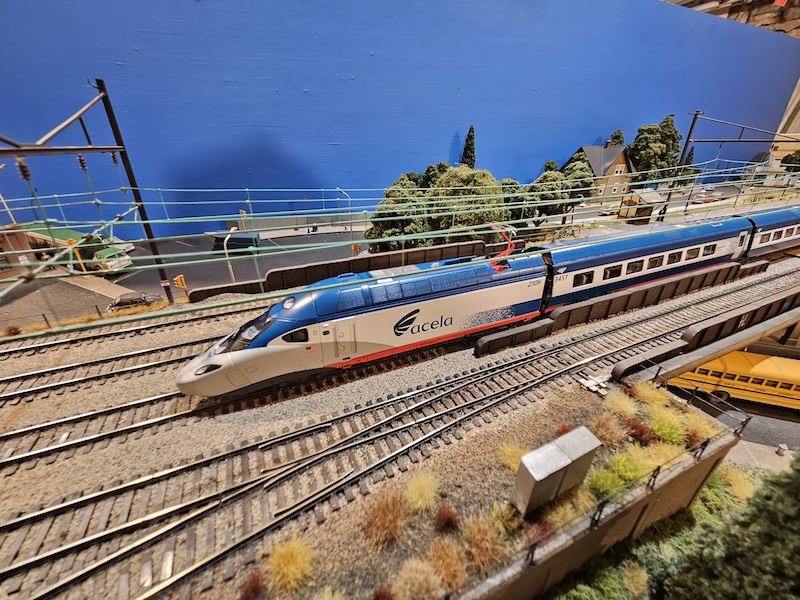
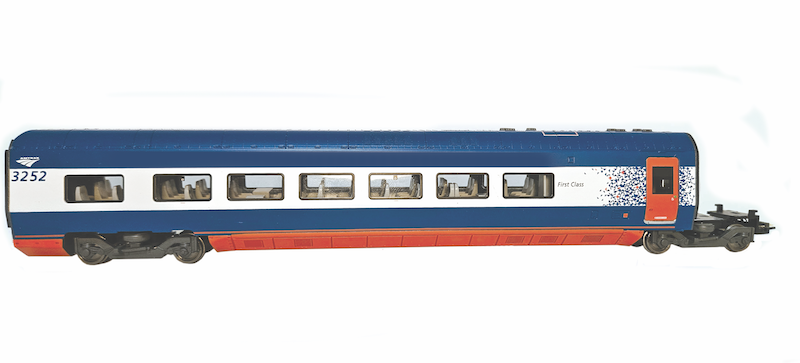
Bachmann Trains has recently released a premium, highly detailed HO scale model of the Acela II in the current Amtrak paint scheme. Our review sample arrived as a “Starter Set” containing a powered and unpowered power car, a First Class coach, a Café car, and a Business Class quiet car as well as Bachmann’s standard speed controller and a loop of concrete tie EZ-Track with eight nine-inch straight sections and sixteen 22” radius curves. Six Business Class expansion cars are also offered separately to create a full eleven-car train set.
While a user manual was not included in the main starter set, each add-on car includes documentation on coupling cars and the unique Jacobs Bogie setup, as well as a full consist diagram showing the proper order of cars in the train set.
Bachmann has chosen to model Trainset Three, consisting of power cars 2108 and 2109 and passenger cars 3252, 3902, 3610, 3611, 3612, 3352, 3613, 3614, and 3451…