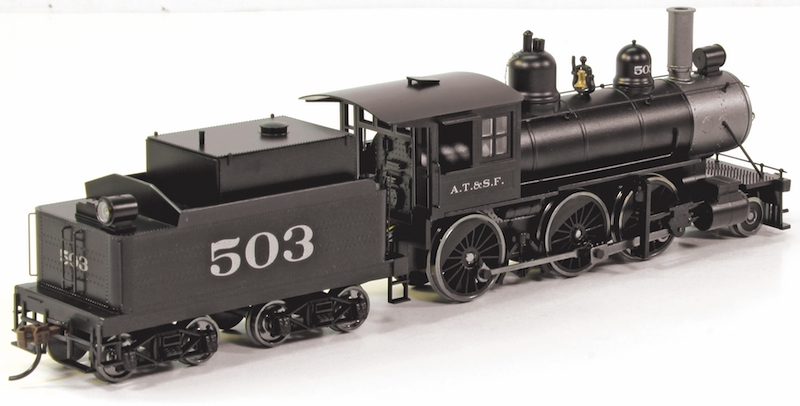

 The 2-6-0 “Mogul” steam locomotive wheel arrangement first appeared as early as 1852. However, it was not until the invention of a free-swiveling front truck designed by Levi Bissell in 1857 that this configuration would become successful and widely adopted. This improvement allowed the locomotive to track well on the roughly laid tracks of early railroads. Louisville & Nashville was credited with receiving the first example in 1864 that used this newly invented feature.
The Mogul’s six drivers provided additional tractive effort when compared to the 4-4-0 “American Standard,” which was the de facto general purpose locomotive of the era, while maintaining an equivalent cylinder and boiler arrangement. The design found ready use in both freight and passenger service where its additional pulling power allowed for longer and heavier trains over more severe grades.
Even though the Moguls were being replaced by 2-8-0, 4-6-0, and 4-4-2 designs by the turn of the 20th century, many of these 2-6-0s persisted in secondary assignments well into the early 1950s.
Like other railroads of the time, Atchison, Topeka & Santa Fe was an amalgamation of a number of smaller rail lines which it had acquired and combined into one system, which led to a mix of locomotive designs from each component road. Only a handful of these classes were large in number; however, since most were built straight from the manufacturer’s catalog they were all mechanically similar. Santa Fe rostered roughly 105 of the 2-6-0 wheel arrangement divided among 15 different classes, many hosting only one or two examples with the largest class boasting 35 engines. Ironically, the two largest groups, the 566- and 591-Classes, would be rebuilt into 0-6-0 and 0-8-0 switchers.
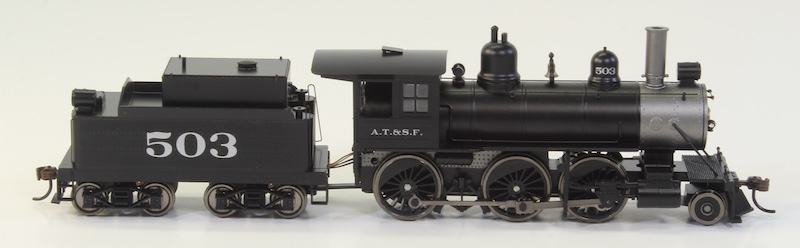
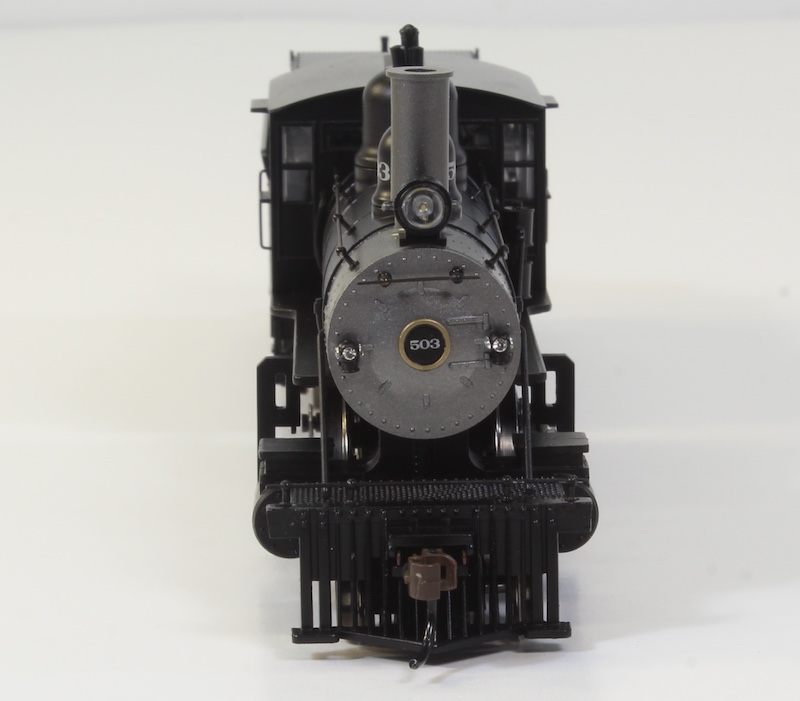
While Athearn’s offering is loosely based on an off-the-rack, turn-of-the-century Mogul with 63” drivers, the choice of road number did pose some questions. Our review sample No. 503 could have two possible heritages. The first would be one of two locomotives numbered 503 and 504, built by Alco-Cooke in 1906 for Pueblo & Arkansas Valley Railroad located in Colorado. The second option would be the 865-Class which was initially numbered 501 through 505 before being renumbered 865 through 869. Built by Baldwin in 1906, they were inherited from the acquisition of Oklahoma Central. Either group would have been retired and scrapped by 1931 due to the downturn brought on by the Great Depression, when many older locomotives were removed. This makes locating photographs of these locomotives nearly impossible, since amateur railroad photography did not become widespread until the 1930s. That said, a builder’s photograph of Denver, Enid & Gulf No. 15 shows a similar 1906 Baldwin locomotive as a contemporary of the two classes that are referenced as possible candidates. The circular builder’s plate on the smoke box of the model tends to support that the model is based on a Baldwin…