
 by Eric Williams/photos by the author
I was out of model railroading for 20 years, instead focusing on railroad photography. But that time trackside has allowed me to hone my interests in model railroading. I wanted to model the type of railroading that I seek out to photograph. My heart races when I stumble across weed-covered rusty rails, that are still active but see infrequent use. It could be a short line or a branch line of a regional or Class 1 railroad. These operations hold on due to carload business, which may be either last or first mile in nature, providing plenty of crew interactions at a human pace. I wanted to replicate this type of railroading on a small shelf layout where I could model a scale version of what I seek out in the real world.
While there are plenty of contemporary examples that I could model, I didn’t want to be limited by their existing physical plant or operations. Also, knowing that my space is limited, I didn’t want to compress a prototype scene into a caricature of the real thing. For modeling inspiration, I looked back in time to the late 1970s and early 1980s, to railroads such as Wellsville, Addison & Galeton; Middletown & New Jersey; Lamoille Valley; and the many branch lines of Boston & Maine. These roads clung on with carload business in economically struggling towns, with right-of-ways that showed years of deferred maintenance.
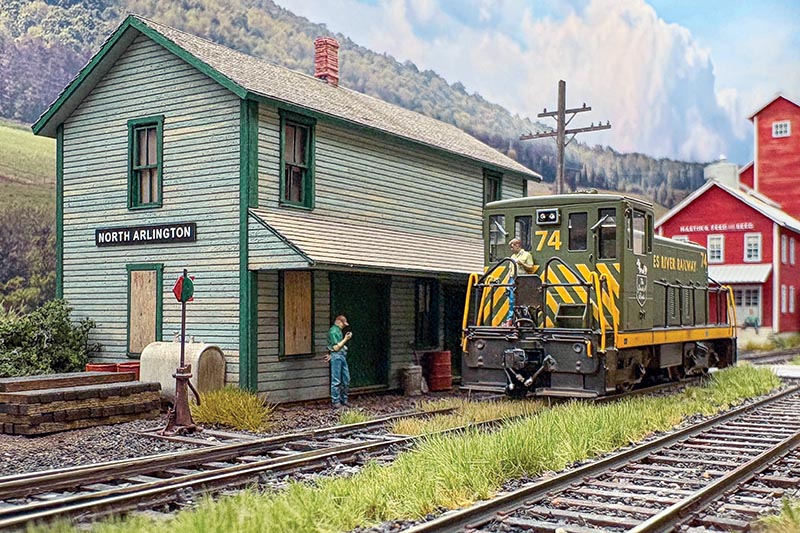
ABOVE: It hasn’t received passengers since the late 1940s, but the railroad retains the North Arlington depot as a crew base. GE 70-tonner 74 passes the boarded-up structure.
With a fresh start back in the hobby, my goal was to design and complete an operating and scenicked model railroad in a relatively short time. I’ve learned from other experiences that it’s important to keep momentum going to finish a project. By keeping my layout small, I figured It would allow me to rapidly learn and progress through all the basics of model railroading; benchwork, track, ballasting, wiring, DCC, backdrops, lighting, and scenery.
Besides learning and applying the basics of model railroading, my other challenge was to to do so in a small space. Room for a layout is limited in my home, as is a space that I can make a mess with power tools or spray paint. That gave me a secondary goal to see how I could simplify the layout’s construction and installation, while challenging some norms of the hobby.
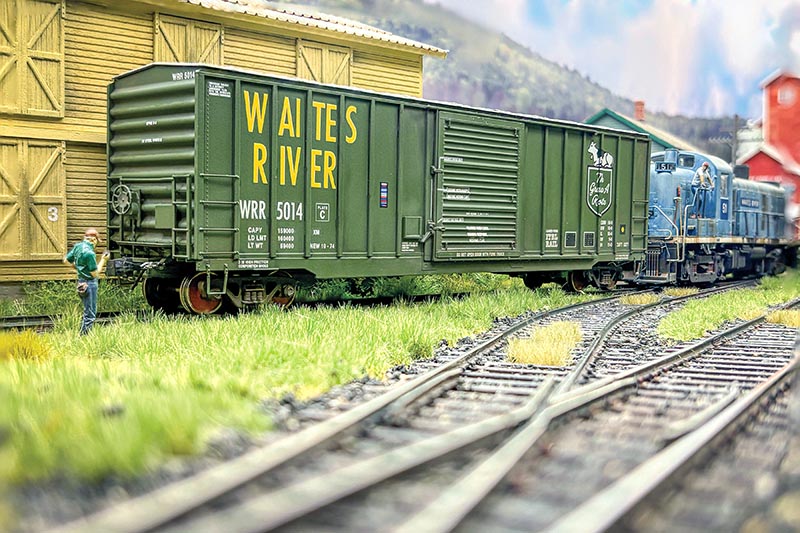
ABOVE: The Waites River Railway has a small fleet of “incentive per diem” boxcars that roam the national rail network. A number of short lines in the Northeast had fleets of IPD boxcars in this era to bolster the fleet of available cars and generate extra revenue.
Concept
The space available for my layout is a bedroom wall, just shy of 9’ long. I’ve long been an admirer of European-style shelf and exhibition layouts, where trains enter and leave the scenicked part of the railroad, often on a removable cassette (also called a “fiddlestick”). Much of my inspiration came from reading Iain Rice’s books on the subject, and more recently, the work of his fellow Englishmen James Hilton and Chris Nevard, who all use the term “cameo” for such a design. Each considers the layout as theater and uses set design principles to direct and control the viewer’s immersion experience. This is done by fixing the layout’s height, flanks, valance, background, and lighting to direct the eyes into a scene and away from any real-world references. These ideas strongly resonate with me as I’m a professional designer and use many of these same concepts in my work.
With my space limitation, I conceived plans for a 72×18” layout, with a 30”-long cassette that would sit on shelf brackets attached to my bedroom wall. For my model railroad theme, the railroad needed be a short line, with marginal business to justify short trains of one to five cars. Such a railroad would operate economical small locomotives, such as the General Electric 44-ton switcher. Setting the railroad in 1978 allowed for a majority of 40’ long cars, with a mixture of 50’ cars. I also chose that year as it was prior to the wholesale changes in the industry brought about by the Staggers Act, a period before railroad graffiti, and allowed for a good mix of car types and pre-merger railroad names.
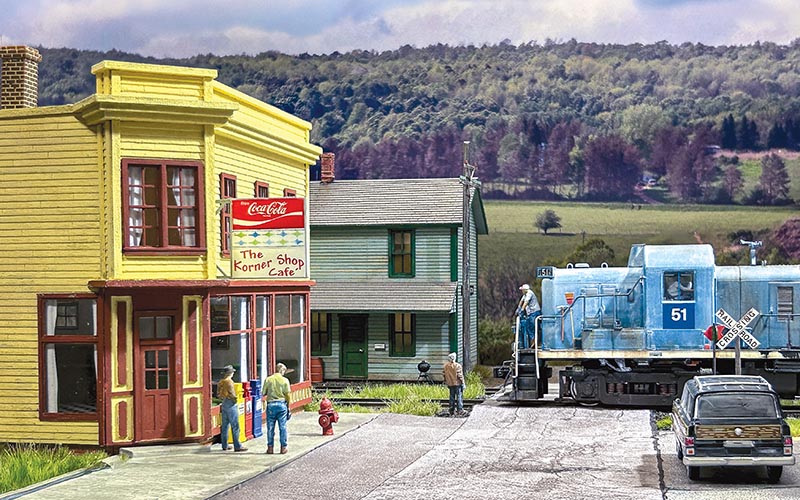
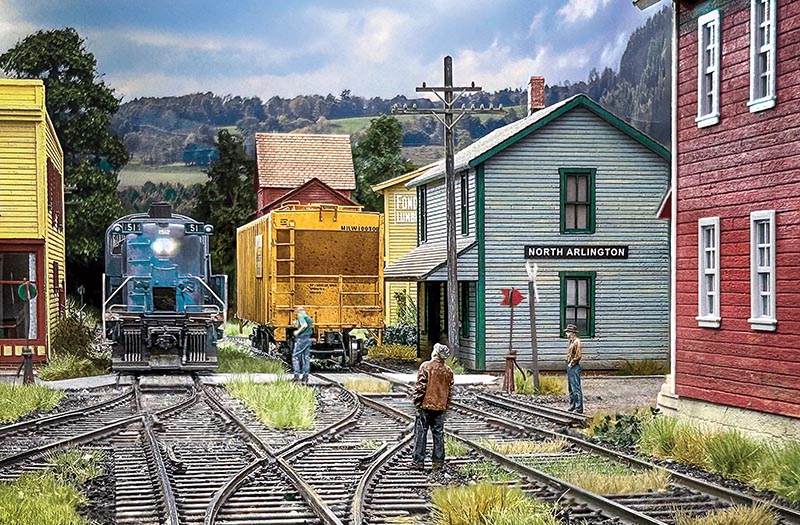
ABOVE: After a hearty breakfast, a couple of customers bring out their morning coffee to watch the train do some work in North Arlington. In a town of this size, entertainment can come in many forms, including a passing Alco switcher.
I narrowed my layout theme to a small Northeastern town, located somewhere in upstate Vermont. In the fictional town of North Arlington, I wanted an abandoned depot, a passing track, and a few industries typical to the region. Since I only had room on one side for trains to enter and depart, my imagined railroad’s tracks extend beyond the town, but the tracks are embargoed due to insufficient traffic.
After mulling over names for the railroad, I settled on the Waites River Railway, a name that sounded familiar from my frequent travels in upstate New York and Vermont…
