
 by Steve Lee/photos by the author
My upcoming layout project features the Pacific Electric, the interurban that propelled the rapid growth of Los Angeles and southern California in the first half of the 20th century. Touted as the largest electric railway in the world, PE operated a 500-mile system of local streetcar lines and interurban routes that stretched from Los Angeles to San Bernardino, Santa Monica, Long Beach, and Santa Ana. A subsidiary of Southern Pacific, PE also operated a modest freight service. The local lines were converted to bus operation through the 1940s, and the remaining interurban routes were sold to Metropolitan Coach Lines in 1963. Los Angeles Metropolitan Transportation Authority took over in 1958, and the last line to be abandoned was the Long Beach route in 1961. PE continued operating local freight using diesels, and was merged into SP in 1965. Of note, Union Pacific continues to operate a former PE line through Torrance to this day.
My layout will need a small fleet of PE cars and locomotives. Modelers of interurban and traction railroads, including the PE, are only rarely treated to new, state-of-the-art releases. Instead, we scour the secondhand marketplace of train shows, eBay, and specialized brass and traction dealers offering a “back catalog” of traction models that can be excellent starting points for such great-looking and -running traction models.
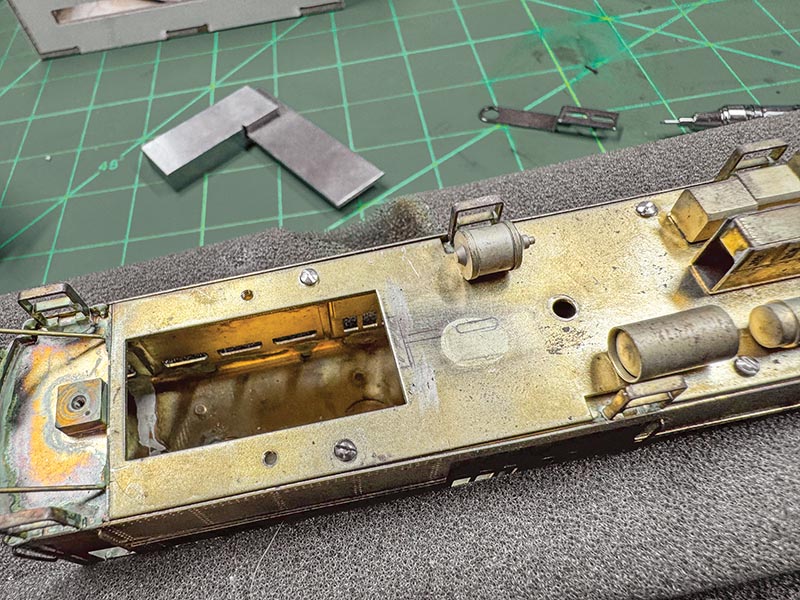
ABOVE: Pencil marks on PE 1459 floor for cutting and drilling for Tenshodo tongue bolster.
For my initial PE fleet project, I went into that back catalog of classic brass train models that are as old as I am — or even older! — and added a boost of 21st century electrical, mechanical, and finishing effort to start building and finishing my fleet of PE cars.
Pacific Electric Box Motor Models in HO
Pacific Electric, like the Pennsylvania Railroad or Rio Grande narrow gauge, has been particularly favored by model railroad manufacturers over the history of our hobby. Southern California-based company Suydam imported a number of brass HO traction models from Japan, including numerous PE cars and locomotives, from the 1950s through the 1970s. A few others also imported brass PE models in the 1980s and 1990s.
Brass traction models like the three PE box motors I selected for this initial project are among the less expensive brass interurban models readily obtained, and are priced competitively with the various short-run 3D-printed kits that have become available in recent years. Updating and finishing old brass cars also requires similar intermediate-to-advanced modeling and finishing skills, as well as additional component purchases such as power trucks and wheel sets. I acquired my cars from eBay sellers.

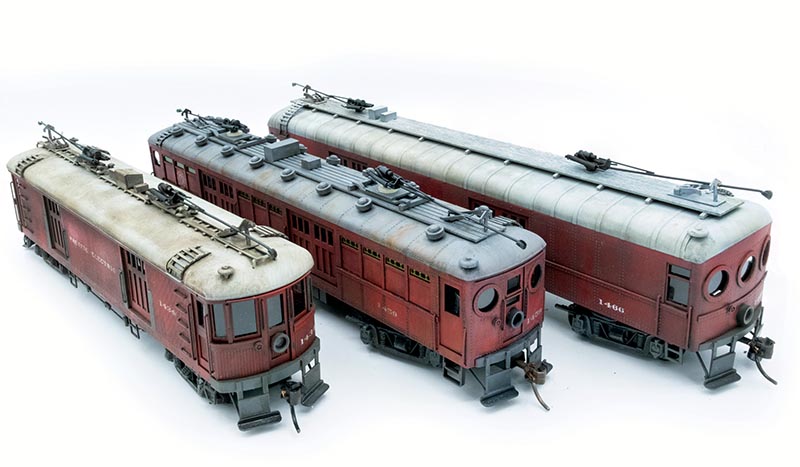
ABOVE: PE 1434 and 1466 were sprayed with thinned black primer.
Suydam models, like most brass models available in the 1960s and 1970s, get the lines of these fascinating prototypes right, with occasionally dated fidelity to detail and construction: perhaps oversized rivets or wire parts, solder blobs, or visible motors, wires, gears, or screws. They were also sold unpainted in bare brass glory, and that is how they are typically found in the secondhand market. This initial project tests out how well modern painting and finishing techniques can overcome these minor appearance glitches.
Also, like most vintage brass, the Suydam models are typically mediocre or even poor performers, with motors and wiring unsuited for modern DCC. Suydam’s models all used a spring belt drive that has built-in limitations, like binding on curves and difficulty in consistently tuning to smoothness. For this initial project, I opted to replace outright Suydam’s open-frame motor and spring belt drive with a modern, DCC-friendly power truck, boosted by a high-quality DCC decoder and keep-alive/power pack capacitor.
My layout will model PE express package and freight operations, which feature box motors. A box motor also makes an ideal first brass interurban project, because it has a minimal interior and windows in need of glazing. For my initial fleet, I focused on three Suydam box motor models.
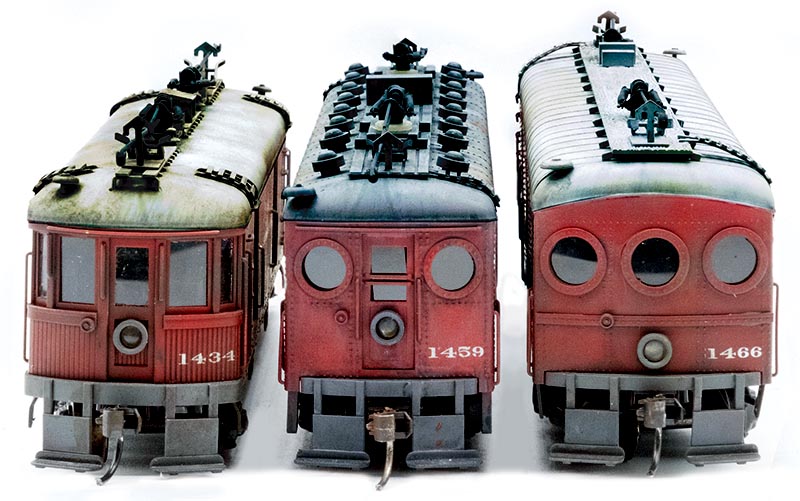
Pacific Electric 1459 is a converted coach with visually interesting side details, including stained glass transom windows that add a dash of color. Car 1466 is a “Blimp” box motor, the largest and most modern box motor type on the PE. Car 1434 was among the oldest box motors operating in my chosen era, the late 40s and early 50s, and features wood construction and truss rod frame.
I referred liberally to Pacific Electric Cars: A Pictorial Journey, 1911-1953, by David L. Garcia and Joseph A. Strapac (Southern Pacific Historical and Technical Society, 2013), and Pacific Electric In Color, Vol. 1 and Vol. 2, by P. Allen Copeland (Morning Sun, 1997, 1999) throughout planning and execution of the box motor project, especially painting and finishing.
The models were vintage, and at least fifty or sixty years old. Car 1459 included the original Suydam printed instructions, clear and printed “stained glass” glazing material made from acetate, and, remarkably, decals. The other cars also included instructions. All three models were in overall good shape visually, with manageable tarnish and grime. A few parts, such as footboards, trolley poles, and lockdown hooks were bent or loose, but easily bent back to their correct shapes and/or secured with a drop of cyanoacrylate adhesive (CA). The models operated out of their boxes on analog DC as expected: barely, noisily, and speed range came in a choice of “on” or “off,” while producing a nostalgically charming ozone smell…
