
 Review by Harry K. Wong/photos by the author
For decades, PECO has earned an enviable reputation as a renowned manufacturer of model railroad products in a variety of scales to customers worldwide. In recent years, they have developed an extensive line of HO “83 Line” Code 83 and “70 Line” Code 70 track components targeted specifically for the North American market. Each of these offerings is designed according to AREA (American Railway Engineering Association) standards.
To recap, Code 83 rail means that the rail itself measures .083” in height, which is closest to the height of 132- or 136-lb. rail seen most commonly in main line settings here in North America. However, sidings and secondary tracks typically make use of lighter rail which measures out around 105- to 110-lbs. per yard. Lighter trackage is addressed by PECO’s “70 line” offerings using Code 70 rail.
PECO’s Code 70 rail measures .070” high with the head of the rail measuring .031” wide. The bottom “web” of the rail is .068” wide. “70 Line” track offerings are designed to to support the NMRA RP-25 S4 wheel standard, and can accommodate a maximum flange depth of .042”. By comparison, PECO’s Code 83 allows a maximum flange depth of .055”. Maximum flange depth is .028” for flanges conforming to NMRA RP-25 S4.
New PECO Unifrog No. 8 Turnouts
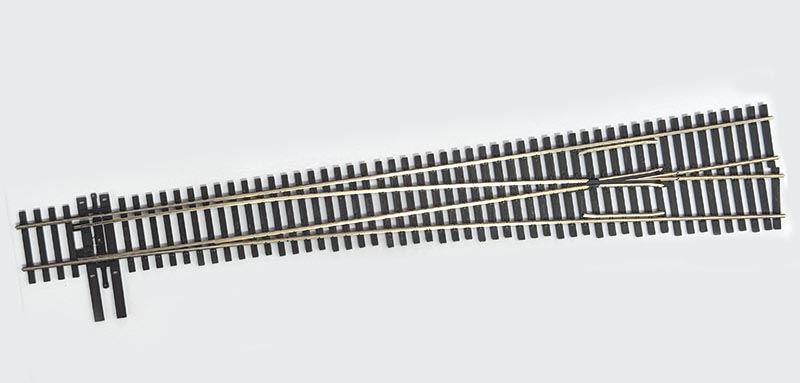
PECO has recently released all-new No. 8 turnouts in both left-hand and right-hand configurations, available in Code 83 and Code 70 versions. From a track-planning perspective, the No. 8 turnouts in both rail sizes share identical dimensions.
For many years, PECO has offered modelers a choice between powered and insulated frogs across its turnout line. Turnouts with fully plastic, insulated frogs are marketed as Insulfrog, while those featuring all-metal frogs are branded as Electrofrog. For example, a Code 83 No. 6 right-hand turnout has traditionally been available in either Electrofrog or Insulfrog form.
As the name implies, Electrofrog turnouts allow the frog and frog rails to be powered according to the position of the switch points, providing continuous electrical contact as locomotives and rolling stock pass through the frog without stalling. Each Electrofrog includes a wire that can be connected to a switch machine, ground throw, or an automatic polarity-sensing device such as a Frog Juicer. Insulfrog turnouts, by contrast, have no provision for powering the frog and, unlike Electrofrog designs, do not require insulated rail joiners at the frog rails.
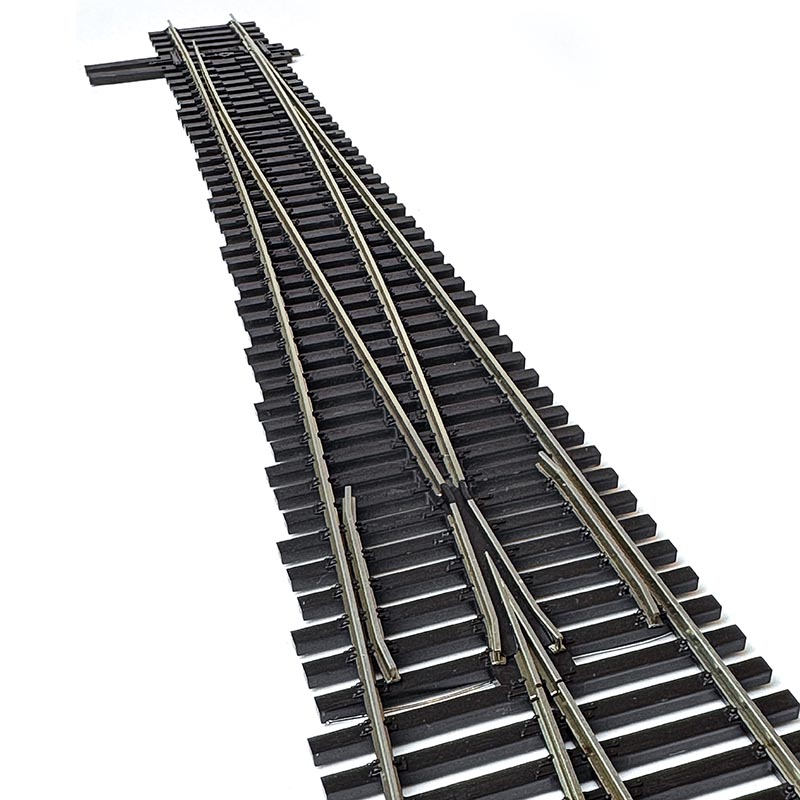
Given these divergent paths in frog implementations, PECO has introduced an all-new frog design — the “Unifrog” — which combines the best attributes of the Insulfrog and Electrofrog into a single turnout. Straight out of the box, each Unifrog turnout is DCC-friendly, and powering the frog is optional. For those who desire to power the frog, a wire is already pre-soldered to the frog, ready for connection to a turnout motor or ground throw with contacts, or to an automatic polarity sensing circuit. Current jumpers between the stock and closure rails and between the stock and frog rails provide electrical current to each so there are no dead spots or need to provide insulated joiners at the frog rails.
All of our samples were in full compliance with our NMRA track gauge. Per the instructions, we used PECO’s SL-110 track joiners to mate tracks together. For Code 70 to Code 83 track transitions, Peco recommends using their SL-115 transition track.
As with all PECO turnouts, the switch points are held in place with a snap action spring that eliminates the need for a separate manual ground throw. However, if you prefer to install a switch machine or a manual ground throw, the snap action spring can easily be removed by prying off the cover to the spring with a jeweler’s screwdriver, and replacing the cover afterwards.
Each switch point and closure rail of Unifrog turnouts is machined from a single continuous section of rail for better conductivity, reliability and smoothness of operation, and a more realistic appearance than in the past with points made of pressed metal.
As with their ”83 Line” turnouts, PECO’s “70 Line” No. 8 Unifrog turnouts are nicely detailed with two finely scaled spikes per fishplate, along with rail brace and rail plate detail near and under the switch points. If two PECO No. 8 turnouts are arranged to create a crossover, the resulting track centers are 2 inches apart, the same as that on a Walthers No. 6 double crossover. Of course, this can be altered as needed. Each of the turnouts provided flawless and smooth transit for both locomotives and rolling stock with no apparent catching on the points or frogs.
PECO’s No. 8 Unifrog turnouts combine improved prototype fidelity with straightforward installation, building on the reliability for which they are well-known. Their geometry and appearance make them a welcome addition for modelers seeking more realistic trackwork, and we look forward to seeing future offerings in the Unifrog series.
PECO Code 70 and Code 83 Unifrog No. 8 Turnouts
L-U8381 Code 83 Unifrog
No. 8 Right Hand Turnout
SL-U8382 Code 83 Unifrog
No. 8 Left Hand Turnout
SL-U7081 Code 70 Unifrog
No. 8 Right Hand Turnout
SL-U7082 Code 70 Unifrog
No. 8 Left Hand Turnout
Contact your favorite dealer for pricing and to order.
Pritchard Patent Product Co. Ltd.
Beer, Devon, England