
 by Bob Van Gelder/photos by the author
In the late 1980s, we purchased our dream home in the small Berkshire Hills town where I grew up in western Massachusetts. As a source of modeling inspiration, the setting could not have been better. Our property encompassed several acres along the South River, a tributary of the nearby Deerfield River, with the former Boston & Maine Fitchburg Division hugging the north bank. Across the river lay the abandoned roadbed of the New York, New Haven & Hartford, along with traces of its interchange with the long-gone Conway Street Railway, which once ran directly past our house. When we first moved in, an old Warren truss rail bridge still spanned the river at the corner of the property. Though the trolley line and the New Haven had vanished years earlier, the sound of freight whistles drifting through the valley at night remains, carried by trains moving along the single-track main line below.
Eager to begin building a layout, I found it took very little imagination to slip back in time to the steam-to-diesel transition era of the early 1940s through the late 1950s. Even today, the setting continues to inspire my efforts to recreate those years on the South River & Millville.
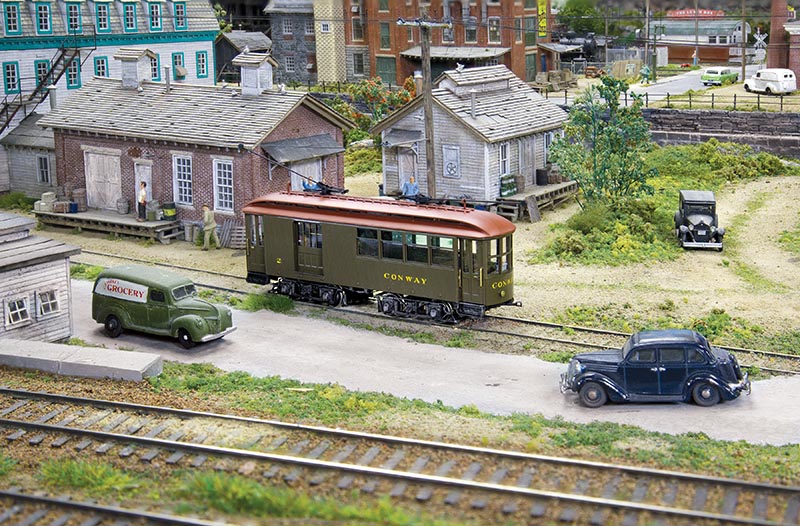
ABOVE: The old Conway Street Railway trolley No. 2 waits for the one or two passengers that want a ride down the hill. The trolley ceased operations in 1920, but some local enthusiasts keep it going for old times’ sake.
Equally important was my immediate connection with the late Dick Elwell, builder of the renowned HO scale Hoosac Valley Railroad. It’s impossible for me to write about my accomplishments in this hobby without acknowledging his influence. Dick was not only a great friend but also a generous mentor whose guidance shaped my work for years. When I first saw his layout, I instantly recognized it as the kind of railroad I wanted to build: a New England landscape served by peddler freights on a single-track main line during the transition era (see January 2012 RMC).
Inspired by Dick, I chose to pursue a similar proto-freelance approach. Well-known Northeastern railroads would interchange with my line and share operating rights over select trackage. Over time, it became clear that our modeling philosophies were perfectly aligned, which helped me refine my concepts and build a model railroad that would host detailed scenes inspired by traditional New England railroading.
I had a solid foundation when I started South River Modelworks (SRMW) in 1991. My background included a fine arts degree that launched my first career as a studio artist, and a master’s degree in landscape architecture that later led me into corporate architectural design and construction. Together, these disciplines sharpened my ability to observe the world closely, while also providing the tools and experience needed to translate those observations into tangible, expressive work.
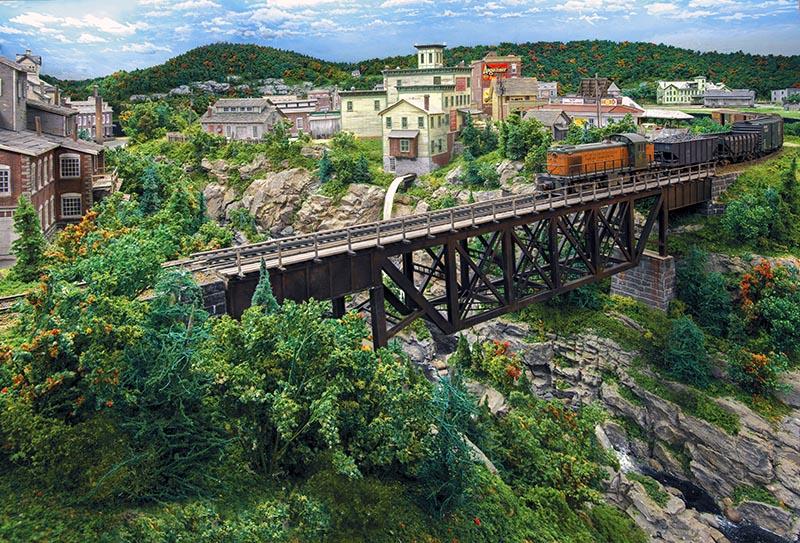
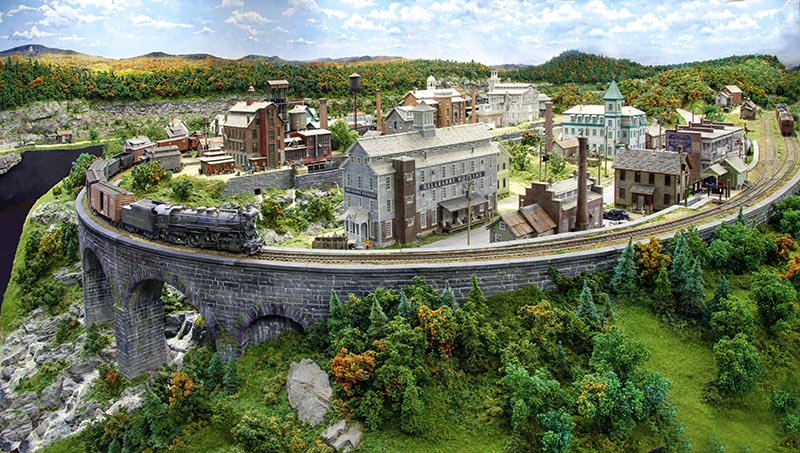
ABOVE: New Haven Alco RS-3 0662 (an Atlas model) pulls a local freight over an inverted Howe truss bridge spanning the Mill River. Hints of of the busy city of Millville can be seen just past the train and the Robinson’s Electric building (SRMW kit no. 330). The bridge is a scratchbuilt test-build by the author.
Making Choices
My first article was published in the July/August 1991 issue of Narrow Gauge & Short Line Gazette. It depicted the Conway BroomShire & Hilltown Railroad, a 30×60” HOn30 narrow gauge display-style layout originally intended to be a module and part of a larger build. Though small, the process of the build really opened up the whole world of model railroading to me.
While there are many ways to approach the hobby, most layouts either focus on appearance, operations, or a combination of the two. While I chose the third option, operational elements are evident throughout my rendition of the SR&M, but operations are not the dominant theme. For me the vast classification yard at East Deerfield, Mass., is as fascinating as a single-track main line snaking down a wooded valley adjacent to a flowing river. Though I would not be considered a strictly prototype modeler, “I model what I see.” Roughly, I arrange the visual elements and themes familiar to me on my layout in a way that dovetails with a plausible operational theory.
I have always been inspired by the fallen flags in the Northeast, starting with Boston & Maine, the New Haven, and New York Central. Scores of photo trips and vacations throughout the region have acquainted me with those and other lines including the Rutland, Central Vermont, and Delaware & Hudson. Physical remnants and documentation of these old lines exist in abundance, making research easy and accurate modeling accessible.
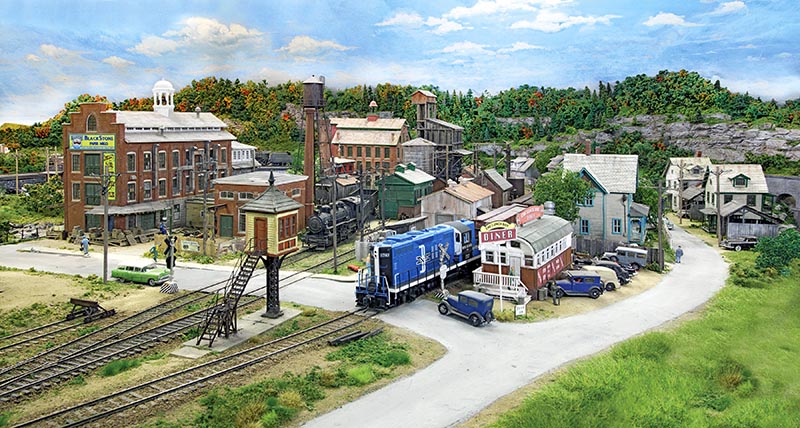
ABOVE: A Proto2000 0-6-0 with an empty cold car sits on a spur track awaiting the passage of a local freight led by a B&M GP9. Customers feel the rumble of the passing freight at the Lunch Box Diner.
Plan and Construction
When I began planning my railroad, I always kept in mind basic guidance from Dick Elwell where he said that he spent the first 10 years laying track on his layout, and the next 10 years ripping up half of it. I have seen many people do the same thing, wishing after the fact that they had adapted the “less is more” philosophy.
Where others spend years analyzing their plans, I drew mine in an evening on a piece of plain copier paper while watching TV. The plan was simple, including a main yard and a wandering main line following the aisles around two peninsulas.
When we first moved in, an old barn on our property was waiting to be renovated. A few years after I completed the workshop for South River Modelworks, I completely renovated a 25×29 ft. space above the shop for my layout. With Dick Elwell’s help, we built the benchwork using L-girders. The roadbed was made from 5/8” plywood supported by spline subroadbed…
