
 by Brooks A. Bentz/photos by Mike Rose
For much of the 20th century, eastern Pennsylvania was served by a dense and varied network of railroads. The eventual collapse of the Central Railroad of New Jersey, Lehigh Valley, Reading, Penn Central, Lehigh & Hudson River, and Erie Lackawanna in the pre-deregulation era reshaped that landscape, leading to the creation of Conrail and the expansion of the Delaware & Hudson in 1976. That moment of transition would later provide the historical foundation for Mike Rose’s current HO scale model railroad.
Mike has been active in the hobby for more than 50 years, and he started building his current layout almost 35 years ago. What started as a proto-freelanced Conrail layout inspired by operations in western New Jersey and northeastern Pennsylvania was transformed in 2016 from the ground up into today’s representation of the Lehigh Line. The turning point came in 2011 during a railfanning trip through unfamiliar territory in northeastern Pennsylvania. While driving along old Route 6, Mike spotted the top of a grain elevator rising above the trees in the small town of Meshoppen. Curious, he turned down the next street and found Kintner Milling, a compact, rail-served grain facility that immediately struck him as something worth modeling. Camera in hand, he documented the mill and its surroundings before following the tracks out of town. A winding drive up and over a hill led him to an unexpected sight: the sprawling Procter & Gamble plant in Mehoopany. That moment helped crystallize an idea that would continue to grow with later visits to Scranton, Pittston, and Allentown — and ultimately led Mike to completely rethink his layout design.
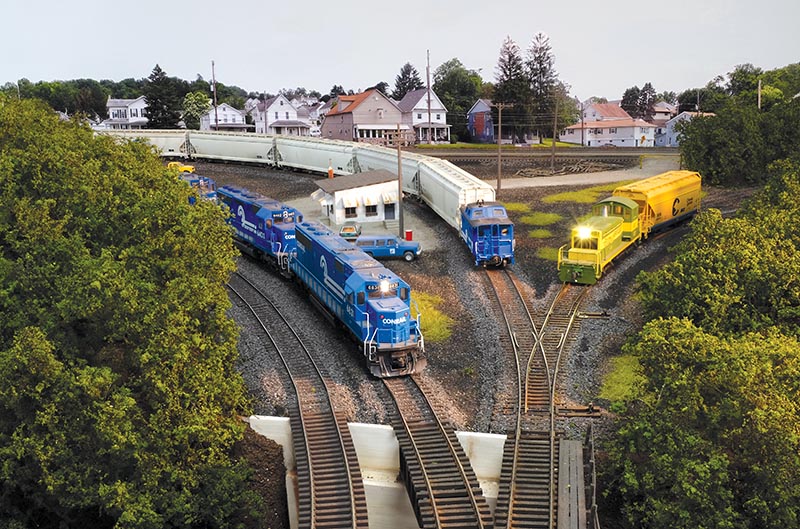
ABOVE: A busy Pittston Junction has Train ALCG on the main line track to the left, a departing “Bloom” local on the Taylor Secondary in the middle, and the short line Pocono Northeast holding on their own tracks on the right. Bridges over the Lackawanna River in the foreground connect Pittston Junction with Pittston Yard proper.
What emerged is a thoughtfully designed HO scale railroad that reflects both careful research and personal experience. Mike’s layout recreates key portions of northeastern Pennsylvania railroading, stretching from Sayre through Pittston to Allentown, an area once anchored by a major joint classification yard serving the Lehigh Valley, CNJ, and Reading, later D&H and Conrail. Our tour centers on the line between Crestwood and Towanda, where Mike has translated his discoveries into a layout that offers rich scenery and demanding operations.
Mike’s railroad is set in 1984, a carefully chosen moment when cabooses were still in service and much of the rolling stock still carried the markings of predecessor roads. Just as important, the Procter & Gamble plant in Mehoopany remained a major rail shipper, anchoring the operating scheme in real-world traffic. Conrail, Delaware & Hudson, and the shortline Pocono Northeast all play roles on the layout, serving a wide range of industries scattered along the line and reinforcing the sense of a busy, transitional-era railroad.
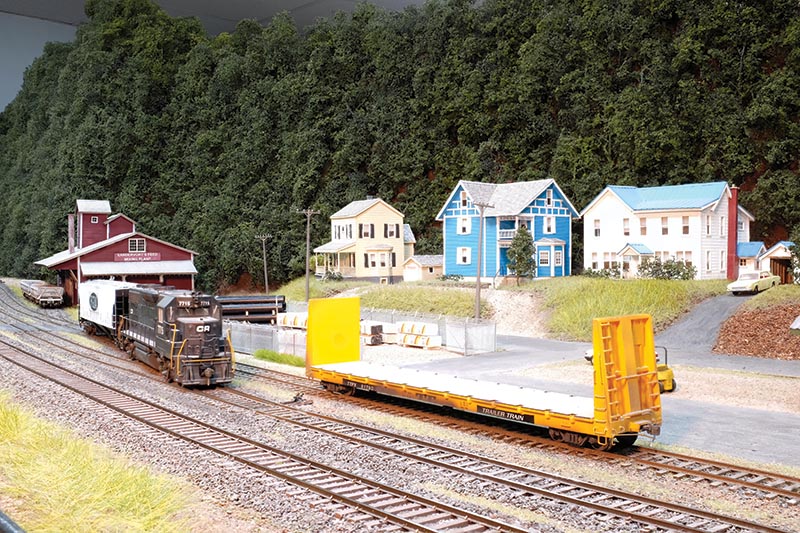
ABOVE: In patched Penn Central paint, GP38 7715 is backing a loaded covered hopper of grain for Wyalusing Purina, with the now-defunct Van Der Voort Feeds to the rear. An empty bulkhead flat for Whipples Lumber in Laceyville is in the foreground. All of the structures shown were built by Rich Cobb from prototype photos that Mike provided.
Underpinning all of this is a strong emphasis on reliable, repeatable operation. Mike’s enjoyment of the hobby is clearly rooted in trains that run well, and that reliability is no accident. The layout is built on sturdy grid-style benchwork of clear pine with ¾-inch plywood subroadbed, providing a solid foundation. Trackwork and wiring receive equal care, with Peco and Micro Engineering track and turnouts, feeders to every section of rail, and a common bus ensuring smooth electrical performance throughout.
Locomotives and rolling stock are treated with the same attention to detail. Wheelsets, coupler heights, and speed matching are carefully checked and corrected as needed, resulting in equipment that performs consistently in operation. Mike’s roster draws heavily from Atlas, Kato, Athearn, and Bowser, with all locomotives equipped with ESU LokSound decoders, power packs, and, in most cases, Scale Sound speakers. Power is supplied by an NCE system, anchored by a Power Pro and three boosters (one for each yard).
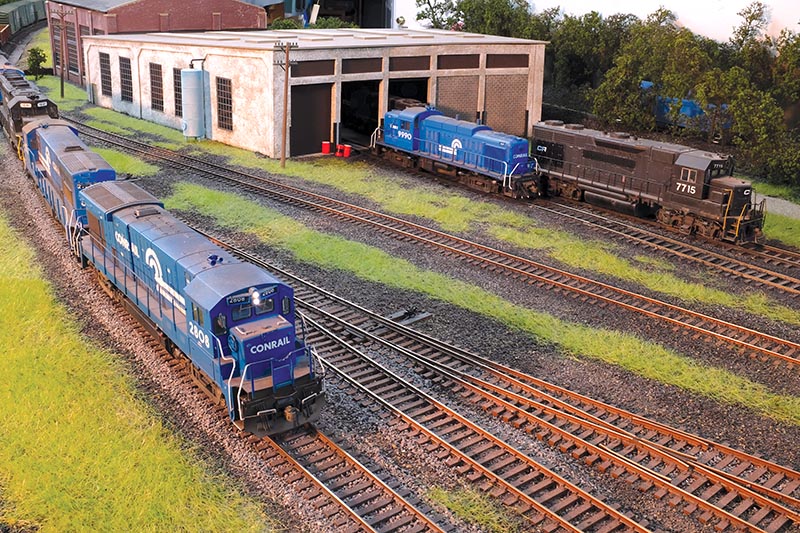
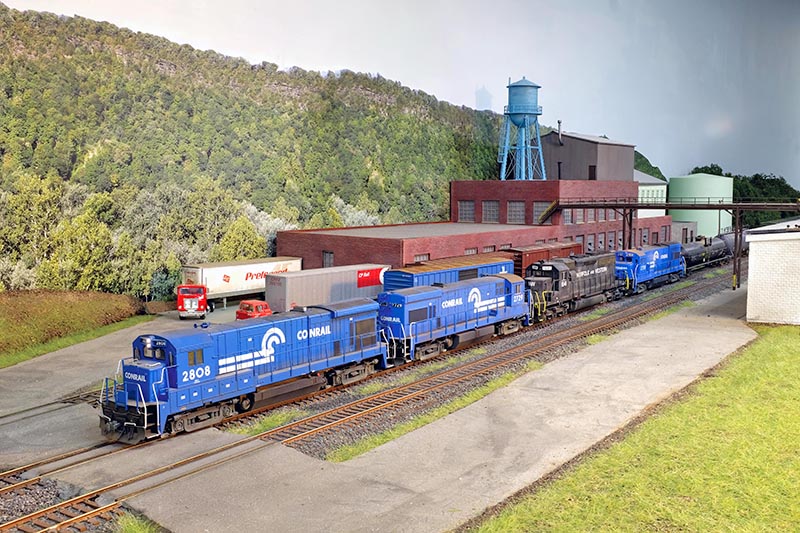
ABOVE: CR 2808 leads southbound CGAL after passing through FALLS at the north end of Pittston Yard. The remnants of the once-mighty Pittston roundhouse are shown, with an old GP38 still in predecessor livery and a “DeWitt” RS-3m languishing there.
Finally, the scenery reinforces the railroad’s sense of place. Ballast is made from real stone, cinders, and even dirt from Mike’s own backyard, while more than 6,000 SuperTrees bring the northeastern Pennsylvania landscape to life. Together, these elements create a railroad that not only looks the part, but operates with the confidence and fluidity of the prototype it portrays.
Large Industries
The railroad is designed for walk-around operations, allowing crews to follow their trains for as much as seven scale miles (roughly 400 feet) along the main line. This approach not only enhances realism, but also keeps operators fully engaged as trains move from scene to scene.
Several major industries anchor the operating scheme. The most prominent are the sprawling Procter & Gamble plant at Mehoopany, Pa., along with Foster Wheeler, CertainTeed, and Dynamit Nobel in the Crestwood area. Both the P&G and Foster Wheeler facilities feature extensive in-plant trackage that provides challenging and highly engaging switching assignments. These track arrangements are based on Conrail Zone-Track-Spot (ZTS) diagrams and closely follow prototype layouts in the Crestwood Industrial Park, while also drawing inspiration from other regional industries such as the Potlatch plant at Ransom, Osram Sylvania in Towanda, and several consignees in the Keyser Valley Industrial Park…
