
 This month marks the 50th anniversary of the creation of the Consolidated Rail Corporation — Conrail, as it was known (except during its first few months when it appeared briefly as “ConRail”). On April 1, 1976, no one knew whether the federal government’s bold plan to rescue six bankrupt Northeastern railroads would succeed. Conrail assumed control of the Central Railroad of New Jersey, Erie Lackawanna, Lehigh & Hudson River, Lehigh Valley, Penn Central, and Reading. Armed with $2 billion in federal funding, the task of transforming a 17,000-mile system spanning 16 states and two Canadian provinces into a functional, profitable railroad was daunting.
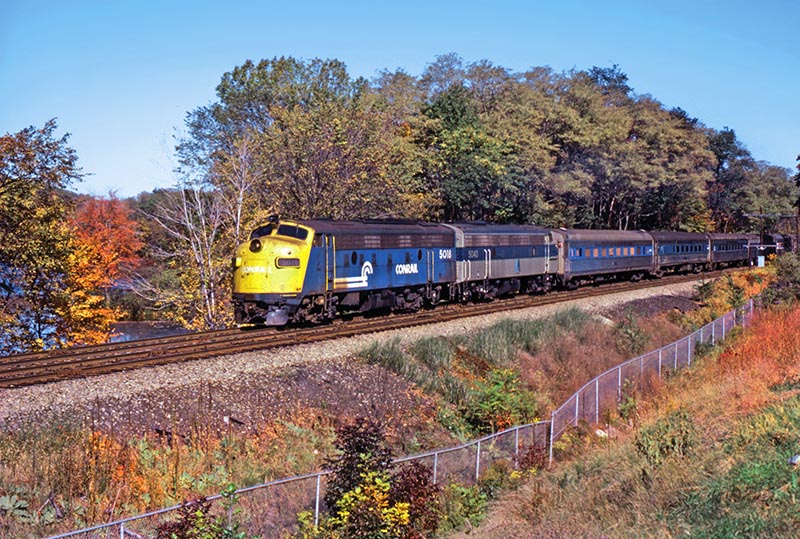
I was born a little more than a year after Conrail was created. By the time I was five years old and riding trains to New York City with my dad, Conrail was already in the midst of abandoning hundreds of miles of excess trackage and modernizing its fleet. While freight was the primary mission, some of my earliest railroading memories include blue-and-yellow EMD FL9s hauling weary, mismatched commuter coaches with steam heat. The state took over the commuter trains in 1983, and Conrail focused on growth and profitability in freight.
When the government was ready to return Conrail back to the private sector, it narrowly missed a sale to Norfolk Southern in favor of an independent ownership bolstered by management and employees alike. The result was the largest initial public offering to date in 1987. By the mid-1990s, Conrail had evolved from a government rescue project into one of the most strategically positioned freight carriers in the country. Its network tied together the densest industrial and consumer markets in the East, and its traffic mix — from intermodal to coal to merchandise — reflected a railroad operating from a position of strength rather than struggling for survival.
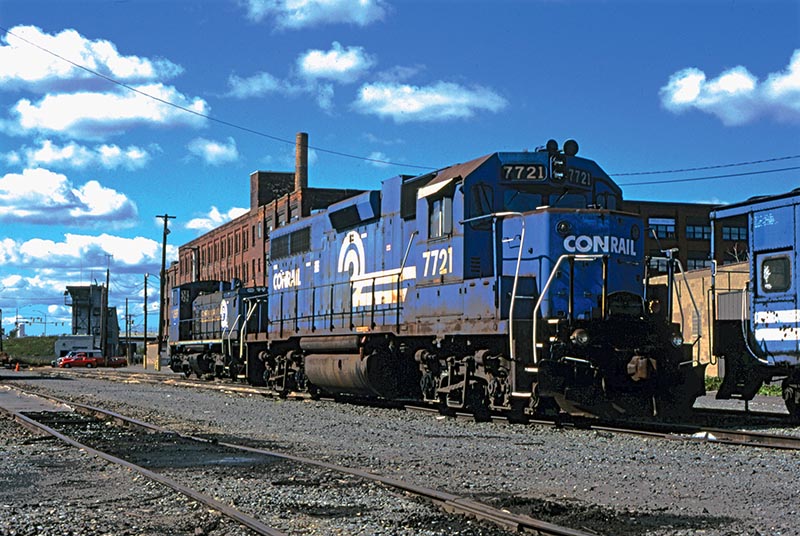
ABOVE: Conrail GP38 7721, at Goodman Street Yard in Rochester, N.Y., on September 17, 1999. —Otto M. Vondrak photo
Much of that success was witnessed from the pages of the magazines I bought off the newsstand. I didn’t have a car or know other railfans yet; if I had, I might have been trackside along the West Shore of the Hudson River in New York, or at Washington Summit in Massachusetts on the Boston Line, or on the famed Middle Division in Pennsylvania to catch the action firsthand. Occasionally my dad and I would stumble across locals at work in various towns in New England or along the Hudson Valley while my mom was busy antiquing or attending art auctions.
Once I finally had a “good” camera in hand and a few railfan friends to share the hobby with, Conrail became my primary subject. My friend Pat Yough made sure I captured a few color slides before I left for college. I didn’t fully appreciate it at the time, but years later I was glad for that handful of shots. When I arrived for school in Rochester, N.Y., my first locomotive cab ride was on a Conrail locomotive, riding the length of Goodman Street Yard with a friendly yard crew. Freight traffic on the Chicago Line was steady and heavy, a near-constant parade of blue locomotives. And if we wanted more variety, the nearby Southern Tier Line offered Big Blue mixing it up with Susquehanna and
Delaware & Hudson trains. For a young railfan, it felt like the center of the railroad universe.
By the time I approached graduation in 1999, however, Conrail’s fate had been sealed. The system was about to be divided between CSX and Norfolk Southern. We spent those final days trackside, trying to document what we could, but the transition came quickly.
A few locomotives lingered in patched paint but even those reminders quickly faded. Traces of Conrail could still be found if you knew where to look, though with each passing year they became harder to find.
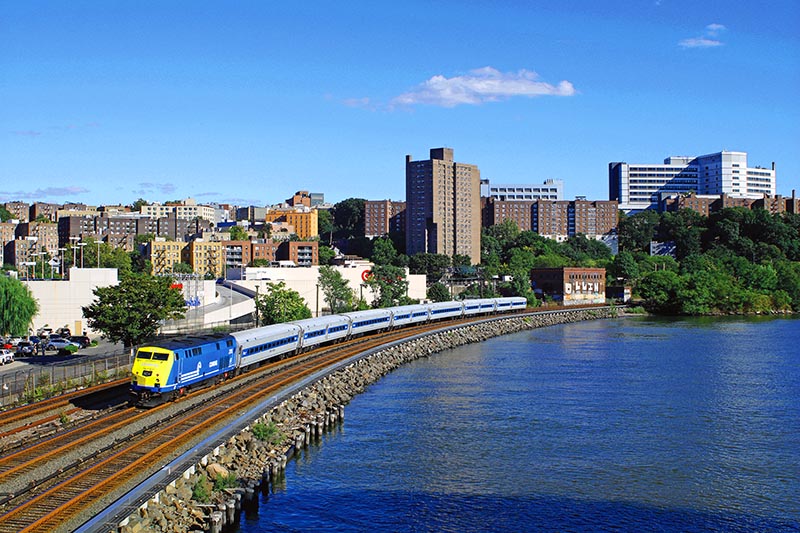
ABOVE: — Northbound Metro-North P32AC-DM 201 on the Hudson Line at Marble Hill, N.Y., on August 30, 2025. In 2023, the unit was wrapped in a tribute paying homage to the Conrail era. —Otto M. Vondrak photo
In recent years, Conrail’s heritage has been celebrated by CSX and Norfolk Southern, as well as commuter agencies such as Metro-North and NJ Transit. It was a thrill to attend Norfolk Southern’s 2012 “Family Portrait” gathering at the North Carolina Transportation Museum in Spencer, photographing NS 8098 alongside tributes to so many other Northeastern fallen flags. And in another moment I never expected to witness again, I stood last summer on the Broadway Bridge over Metro-North’s Hudson Line and photographed blue-and-yellow P32AC-DM 201 rolling along the Harlem River at Marble Hill, conjuring memories of my earliest train rides.
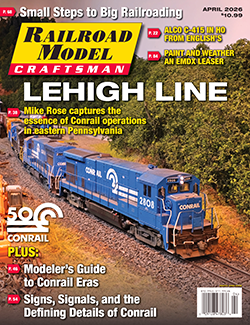
As you turn the pages of this month’s issue, I hope you’ll reflect on what Conrail means to you — whether you watched it struggle, saw it thrive, or discovered it through photographs and models. Fifty years later, Conrail’s legacy still inspires.
—Otto M. Vondrak
