
 There are at least a few polarizing topics in model railroading; DCC versus DC, diesel versus steam, prototype versus freelance; but there’s one that really has me on the fence – graffiti.
We see it everywhere, and you’re hard-pressed to find a car that doesn’t have it, unless you’re standing outside the gates at a railcar manufacturer. Once they hit the open rail, they are a fresh canvas to an awaiting “artist.”
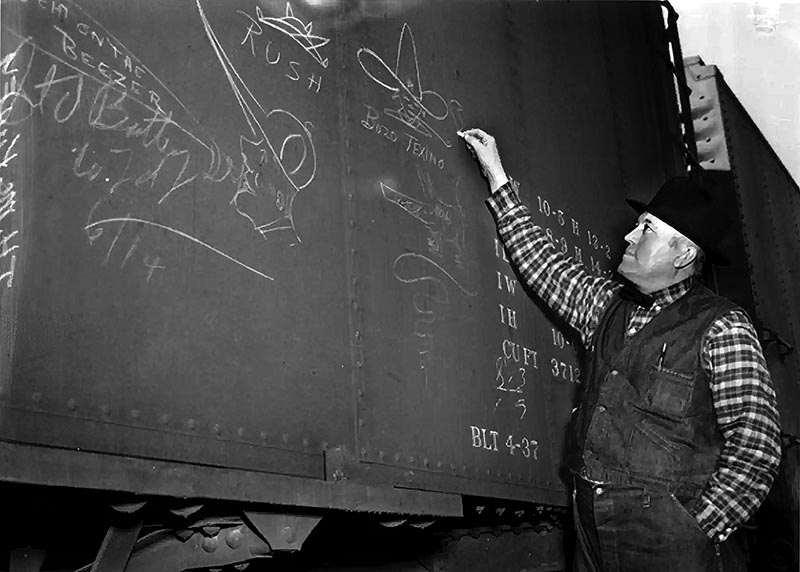
While many people consider graffiti a modern phenomenon, it has actually existed for tens of thousands of years. Most of what we know about Pompeii comes from writing on the walls of the lost city. Another word for these writings or drawings is “monikers,” a tradition with a long history in railroading. In the early 20th century, hobos used simple chalk drawings on railroad buildings and equipment to communicate or let someone know they were there. Railroaders also created their own monikers, little cartoons they left on freight cars to pass the time. One of the most famous was “Palm Tree Herby,” drawn by St. Louis switchman Herbert Mayer. According to legend, he may have drawn on more than 700,000 boxcars. Another well-known moniker was “Bozo Texino,” a cartoon of a smoking character in a wide-brimmed cowboy hat, created by yard worker James Herbert McKinley. In more modern times, perhaps you’ve seen the cowboy figure “Colossus of Roads,” the work of the late Russell Butler (also known as “buZ blurr”).
Modern graffiti, as we know it, started on the East Coast in the 1960s, especially around New York City, where subway cars served as an ideal canvas for those wanting to leave their mark with outrageously colorful murals. In the decades that followed, the trend only grew — much to the dismay of those who where trying to clean up the transit system and the city’s image through the 1970s.
Some of this debate is centered around the concept that modeling graffiti glorifies an illegal act. Well, if this were the case, littering is illegal too; and there are many great modelers that bring realism with rubbish in streets and alleyways. And in society in general? Heck, have you seen “The Sopranos” or “Breaking Bad?” Those wildly popular television shows were based entirely on people doing illegal things.
To be a true, downright accurate prototype model railroader, you’d have to include it, right? I mean, it’s a part of the railroading scene, whether we like it or not, so to “do it right,” wouldn’t one have to take the prototype photo and recreate what’s there, maybe even some of the less desirable words and images?
It was during my Around the Layout podcast interview with model railroader and 1980s TV dad Michael Gross when I was introduced to the term “art as a form of protest.” With model railroading, we can create the world we want to have. We can save a fallen flag, preserve industries, turn back the clock or move it forward and essentially create the world that we want. That can also include limiting or eliminating the elements we don’t like. Maybe that philosophy of protest is just enough to justify saying, “It’s not supposed to be there, so I’m omitting it.”
Or maybe you can embrace parts of it and use it as a way to add local flavor that you can share with others. That’s what Paul Stamp of Bergen, N.Y., is doing. According to his post on his “Paul Stamp’s Finger Lakes Railway” Facebook page, he’s commissioned a decal company to produce replicas of tags from a local who has added graffiti to railcars in the Finger Lakes region. This unknown person uses the tag “Not Graffiti” and Paul has offered to trade these decals with anyone willing to do the same. It’s a new take on the rail pass, and the more recent sticker craze that hit the hobby, and provides a new way for us to connect and share.
If you regularly host operating sessions, there’s another subtle consideration. Part of creating the impression of a larger car fleet is having plenty of rolling stock that blends into the background — cars that do their job without calling attention to themselves. Highly distinctive markings or graffiti can make individual cars easy to remember, which slightly reduces that illusion. That said, a few memorable cars can be a good thing, adding visual interest and conversation points. As with most aspects of the hobby, it’s about finding the balance that works best for how you like to operate.
The best part of this debate is that it ends the same way it began and is the same for all the aforementioned polarizing topics. The right answer is up to you.
—Ray Arnott
