
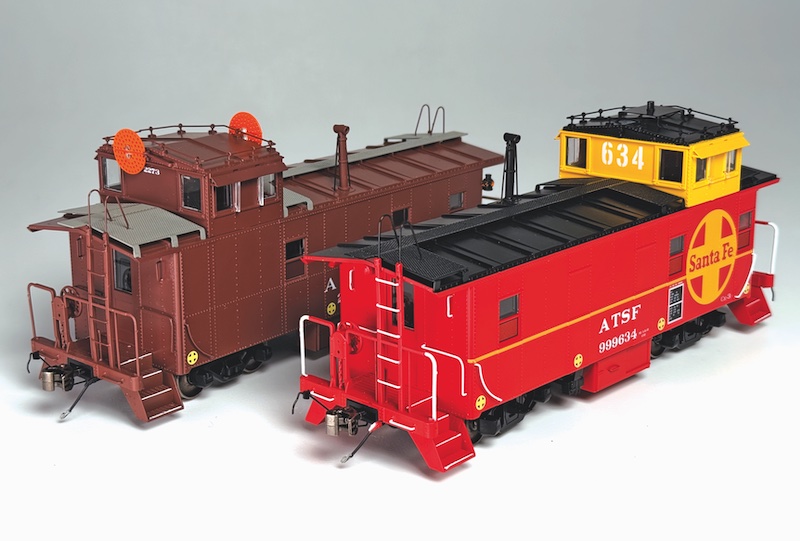
 Perhaps one of the most iconic images in all of railroading is the Santa Fe offset cupola caboose. Literally hundreds of thousands of models of these cars have been produced in various scales over the years from countless manufacturers. However, other than rare handcrafted brass replicas, the peaked-roof versions of these cabooses (known as “waycars” on the Santa Fe) have never been mass produced as plastic models — until now.
Available now from Class One Model Works is a family of Santa Fe offset cupola peaked-roof waycars in three primary variations: as-built cars in mineral brown with wig-wag signals, 1950s-60s era radio-equipped versions of the former, and modernized Ce-3 waycars in bright Indian Red with yellow cupolas that first appeared in 1968.
Drawing from earlier Santa Fe designs, the prototype for Class One’s first caboose models were constructed in Santa Fe’s own car shops in Topeka in 1949. Two 100-car groups were built that year, initially numbered 2201-2300 and 500-599.
Each model features road-number-specific artwork and details, including magnetically activated illuminated lanterns or end markers on all versions tied to a flicker-free capacitor circuit supplied by track power. Details include etched metal rectangular grate or Morton-pattern running boards, etched metal steps, double-hung windows with etched metal lower screens, wire-form metal grab irons, and more.
Underbody equipment details include a Dayco frame-mounted belt-driven generator, full brake rigging and differing tool box configurations. Curiously, these caboose models lack the slightly extended Duryea draft gear that is visible at the ends of the prototype. As the inside of the car is occupied with lighting circuitry, the addition of interior details is left for the purchaser to accomplish.
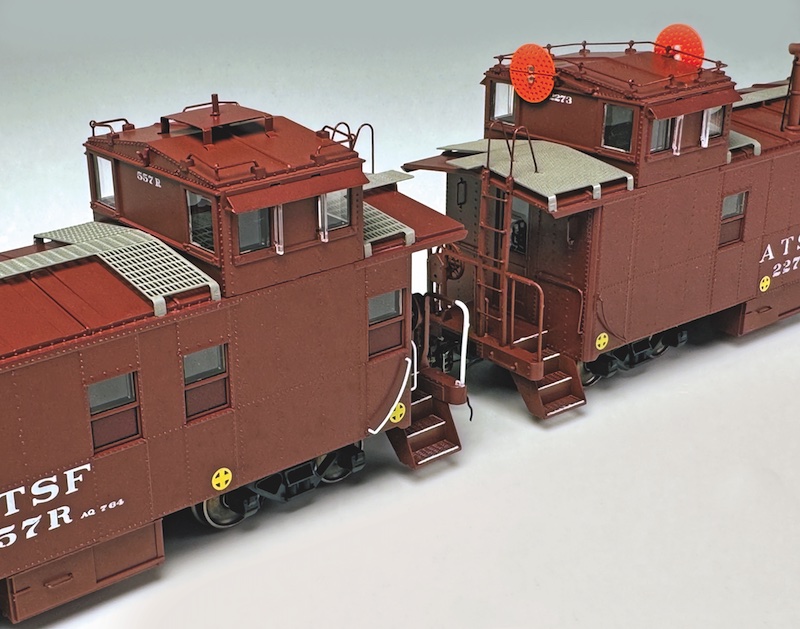
ATSF 2273
With its prototype constructed in 1949, Class One’s HO scale reproduction of Santa Fe caboose 2273 depicts the as-built configuration for these waycars, including the distinctive “wig-wag” signals mounted prominently onto the front and rear faces of the cupola. Before the adoption of radio communications, these wig-wag signals were used to communicate “stop” and “highball” (proceed) instructions from the caboose to the engineer at the head end of the train.
Also a first for ready-to-run mass-produced plastic HO cabooses are the illuminated LED marker lanterns at the end of the car opposite the cupola end…