
 by Keith Kohlmann/photos by the author
I never met Vic Roseman, but his work forever changed my view of model railroading when I first saw his super-realistic photographs in the June 1977 issue of Model Railroader. His photos in that article gave the viewer a ground-level perspective of trains parked at a Central Railroad of New Jersey (CNJ) terminal. The views were similar to what a railfan photographer might have seen during a visit to a railroad yard during the steam-to-diesel transition era. The scenes were created using O scale models posed on a diorama carefully placed along the CNJ right-of-way. His outdoor setting used natural lighting and shadows to both define and subtly hide the details on the models. He placed the diorama at the right distance away from real CNJ railroad structures to define the location of each photograph. He created typical vintage railfan photographs using prototype models. The article went on to express the wish to go back in time to take more photographs of steam and diesel locomotives in the places that have faded away.
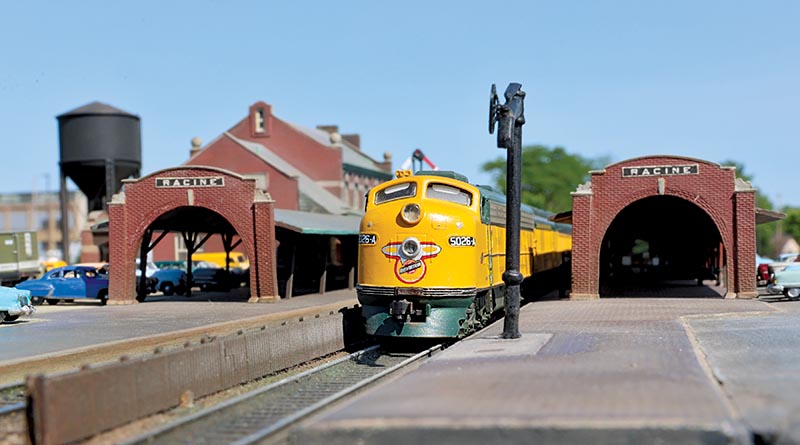
After seeing his images and reading that article, I was hooked on the idea of photographing super-realistic models placed outdoors in historic settings. It set the direction of all my future railfanning and modeling efforts. Like dispatching or operations, this is a subset within the model railroading hobby. I call the images that come from this endeavor “model railfan photography.” Vic passed away in 2024, and what better way to honor his legacy of inspiration?
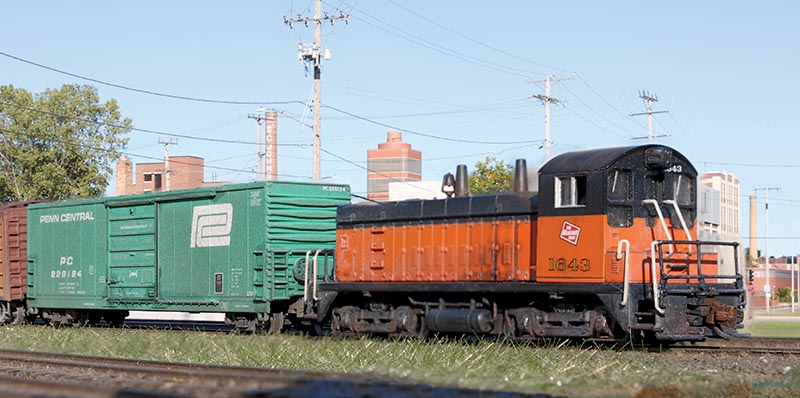
ABOVE: With Frank Lloyd Wright’s iconic Research Tower in the background, the Milwaukee Road’s Racine Patrol has just pulled loads from the shipping dock at the S.C. Johnson Wax Company in June 1973.
Perspective on Scale
Vic worked in O, S, and HO scales. I work in N scale. Each has distinct advantages and disadvantages for creating realistic model railfan photographs. O scale can have far more detailed models, but this means that every surface of the entire model must be highly detailed and in proper proportion, or the neglected parts of the model will look out of place.
O scale allows for much lower camera angles that match the perspective of a scale-sized person viewing the scene. The center of a camera lens can be placed closer to ground level relative to the size of the model. So the larger the scale, the lower the camera’s viewpoint can be, increasing the forced perspective. Placing the camera at the lowest possible angle is one of the tricks to realistically capturing the enormous proportions of prototype trains using models. Very dramatic images are possible using larger-scale models. But modeling a big scene in the larger scales can become an enormous undertaking and can be difficult to manage in the field during an outdoor photo session due to the sheer size of the models and dioramas.
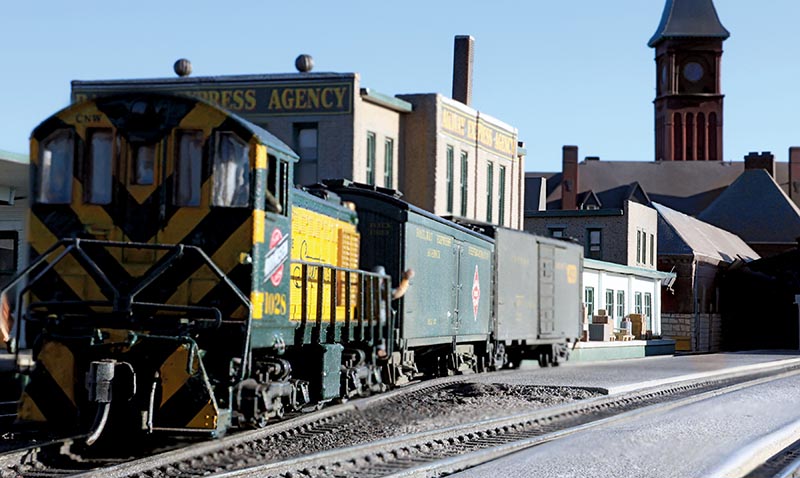
ABOVE: Vic Roseman wrote a comprehensive book about the Railway Express Agency, recently revised and re-released by White River Productions. That information was used to create this prototype model of the REA freight house on the C&NW at Milwaukee, circa 1955.
The primary advantage of working in N scale is that large scenes and structures can be realistically modeled and photographed. A large station, yard, bridge, or industry can fit on a portable module or diorama that can be much easier to transport to a realistic or historic photo location. For my photography I use standard five-foot Modutrak N scale modules or a 12” x 24” posing board.
Fine detail is available on most N scale models. Even molded-on details can be enhanced or minimized using paint and weathering techniques. If the correct proportions are maintained among the details, the lighting and shadows will convince the eye that the scene is believable. Those individual details and pieces of equipment can then be blended as parts of a larger scene that is similar to what a person might see while standing trackside. The goal of this type of modeling is not technical perfection; the goal is authenticity.
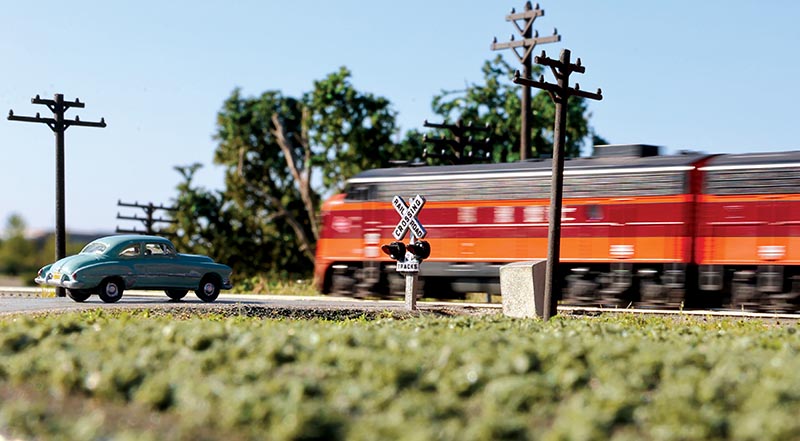
ABOVE: The Milwaukee Road’s Olympian Hiawatha was moving too fast for the railfan photographer to capture a clear image of the train using early Kodachrome 25 slide film.
Lighting
I started out building super-detailed and weathered models in the basement. Fluorescent shop lighting worked well for illuminating the workbench and layout, but this lighting did not truly replicate what I saw outdoors while railfanning. When I tried Vic’s approach and began viewing my models outside in natural sunlight, my unpainted plastic looked shiny or translucent. Shadows exaggerated oversized details, and the bright light made sloppy or incomplete work very visible.
I began modifying my modeling techniques to make accommodations for natural sunlight and an eye-level perspective. Bright sunlight creates beautiful reflections, highlights, and shadows that draw the viewer into the picture. These effects can be anticipated and enhanced while the models are under construction, and then these particular details can be intentionally revealed to the camera by adjusting the lighting conditions and angles. The camera captures details and lighting that cannot be seen by simply looking at the models straight-on or from above. There is an unmistakable instant of recognition when a miniature model is seen from a realistic perspective in a natural setting. The lighting, shadows, and haze create a genuine look of authenticity.
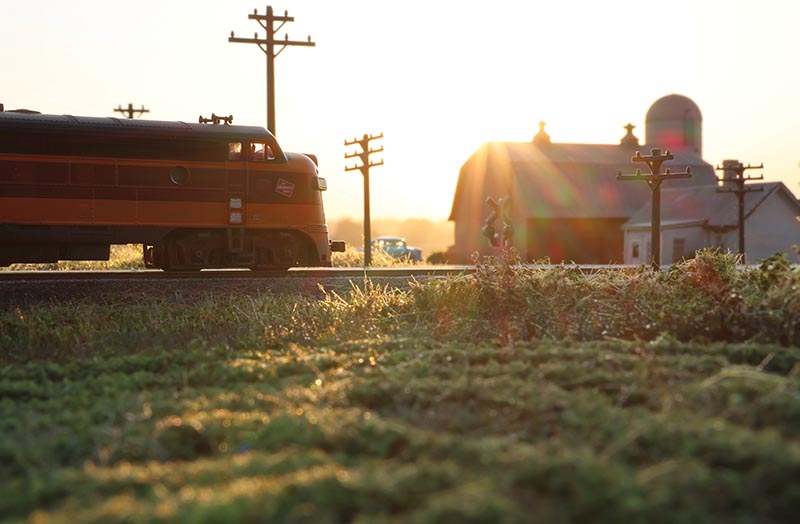
ABOVE: The morning sun rising over Lake Michigan burns a light frost off the harvested cabbage fields as one of the Milwaukee Road Hiawathas passes through Caledonia, Wis.
Reviewing the images after an outdoor photo session will show the modeling and photography techniques that worked and those that will need additional adjustments. The process takes lots of trial and error. Mistakes are part of the process. They free you from previous notions of how it is supposed to be, and open the way to new creative possibilities.
As I developed better techniques, my creativity increased. This made it possible for my model railfan camera to take me to places I had only seen in old black-and-white photographs found in the archives of railroad historical societies. By using prototype models and modules, I could imagine everyday railroad operations that were never documented and start creating faithful images of historic locations in stations, yards, and main lines…
