
 By Harry K. Wong
Today, it is common to see locomotives originally rated at 3,000 horsepower or more assigned to yard switching and low-speed local service. In the 1960s, however, 3,000 horsepower represented a major milestone, as builders competed to produce “high-horsepower” four-axle locomotives suited to fast freight service.
By the early 1960s, Electro-Motive Division of General Motors had pushed the design and reliability limits of the 567-series prime mover and associated electrical gear in its 35-line locomotives at 2,500 horsepower. In response, EMD introduced an all-new line in 1966 built around the 645-series prime mover. At the top of its four-axle freight lineup was the GP40, powered by a 3,000 h.p. 16-cylinder turbocharged 645-series engine. Between 1966 and December 1971, EMD built more than 1,100 GP40s for 28 U.S. railroads, two Mexican lines, and Canadian operators. The model was superseded in EMD’s catalog by the GP40-2 when the builder introduced its Dash-2 line in January 1972.
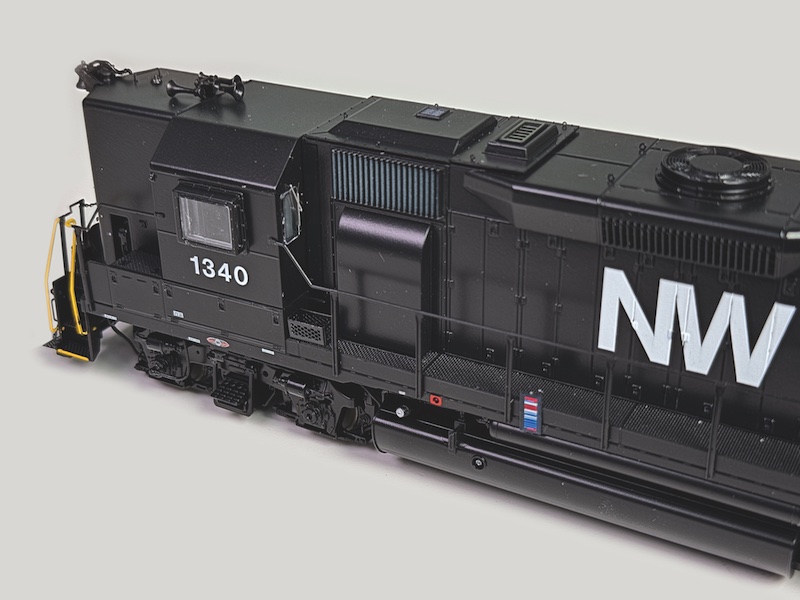
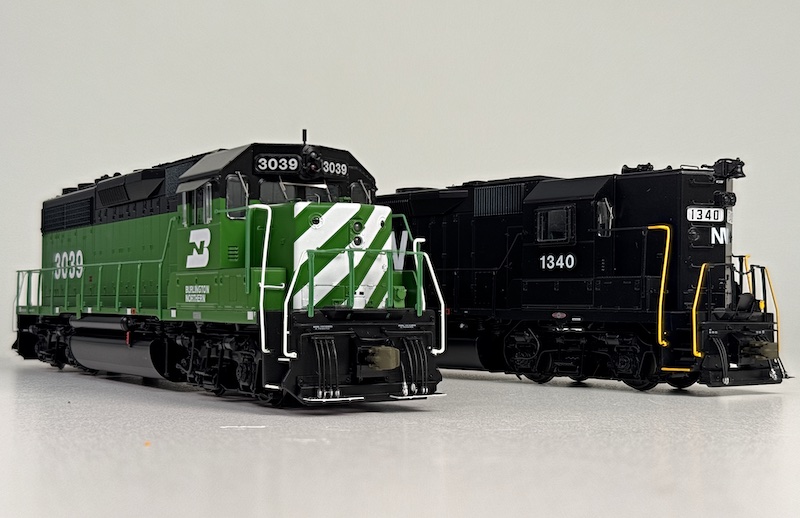
ScaleTrains’ latest release of EMD GP40 locomotives is now available as part of its premium-level “Rivet Counter” line in a multitude of production phases. Each model features an extensive array of road-specific details corresponding to each paint scheme and era.
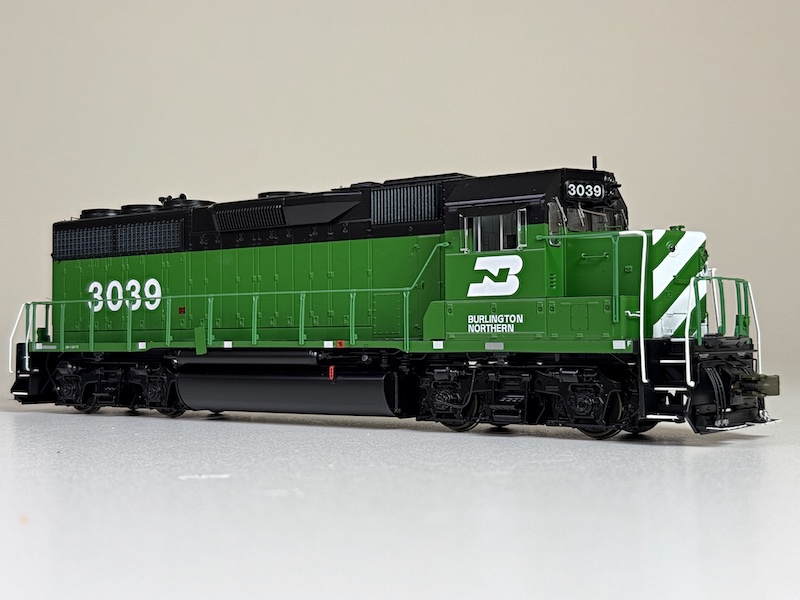
The long list of details on the Rivet Counter GP40s begins with separately applied finely-scaled metal grab irons at the ends of the short and long hoods. Atop the roof behind the cab is the inertial filter hatch, followed by the “turbo” exhaust hatch and 48”-diameter cooling fans. The dynamic brake fan and radiator fans feature photo-etched see-through grilles with fan motor detail and blades correctly positioned at the proper clearance directly underneath. The etched metal lift rings atop the hood differ in diameter per EMD specifications. The walkways feature scale-sized tread plate. The handrails are molded in a slippery engineering plastic with a realistic cross-section and are straight. Under the sill is a maze of traction motor cable conduits, piping for air and sand lines, air filters, fuel fillers, fuel gauges, drain pipes, and more. On and around the pilots are see-through etched metal steps, flexible m.u. hoses, fine scale coupler cut levers and snowplows, see-through footboards and/or m.u. hose catch trays where applicable.
Each truck sideframe features separately applied brake cylinders, air lines, and speed recorder details. Flexible rubber sanding lines connect to the outer brake clasps on each truck — an improvement over the stiffer POM plastic sand lines found on other releases from prior years.
The cab features clear window glass with sliding side window sashes, etched metal windshield wipers, illuminated number boards and a full cab interior with non-lighted control stand, electrical cabinet and seats. While thin in profile, the outer windshield wipers lack the double-arm design present on the prototype. All other details are rendered beautifully in fine-scale relief…