

 by Jason Shron/photos by the author
Memory and nostalgia can be powerful forces in our modeling. Guildwood Station is a modest suburban stop in Scarborough, Ont., at the east end of Toronto. It serves GO Transit commuter trains, but it was also used by Canadian National passenger trains and, after 1978, by VIA Rail trains bound for Kingston, Ottawa, and Montreal. More important to me, it was the first place I ever saw a train and it remained my local station for nearly 40 years.
Construction Planning
I always planned to build a model of Guildwood; I photographed it extensively and even obtained blueprints from GO Transit in the 1990s. I tried to build a Guildwood module back then but was stymied by the difficulty of scratchbuilding the modern, mostly glass station and platform shelters using traditional methods.
I returned to the idea of modeling Guildwood when I was building my triple-deck HO scale Kingston Sub layout in earnest in the 2010s. It was planned for Deck Two, and it was considerably compressed to fit between the end of the room (where the track has to make a 90-degree turn) and a major bridge scene on Deck Three called “Kingston Mills.” This scene was to be quite deep, so it would block the view of the Deck Two tracks.
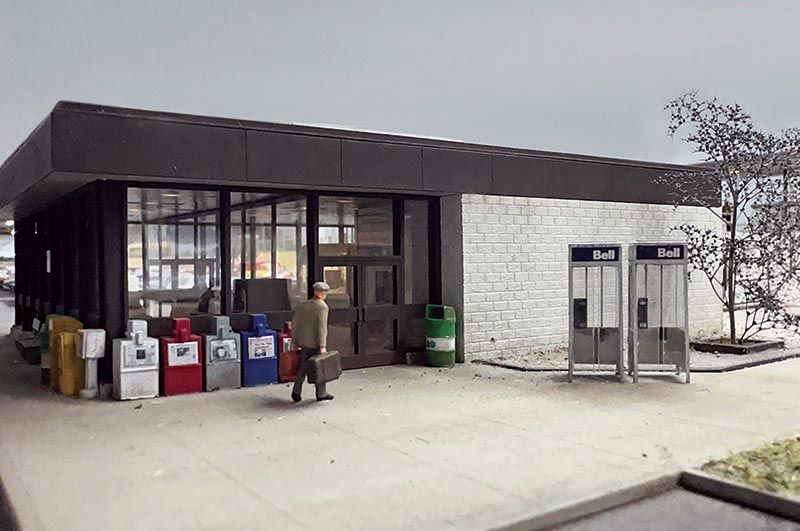
ABOVE: The west side of the station features two details unfamiliar to many young people today: newspaper boxes and telephone booths. The phone booths were scratchbuilt from .005” acrylic and .011” laser board. —Jordan Smith
During the pandemic, I completed much of the scenery and many of the structures on Deck Three. Kingston Mills was the last major piece of the puzzle, but the more I looked at it, the less comfortable I became. I had visited the location only once, in 2012, to photograph and measure it. From the train, it is the kind of place you can miss in the blink of an eye.
Guildwood, by contrast, had a large and permanent home in my heart. Even so, it made little sense to force the scene into the cramped space available and compromise the very qualities that made it meaningful to me.
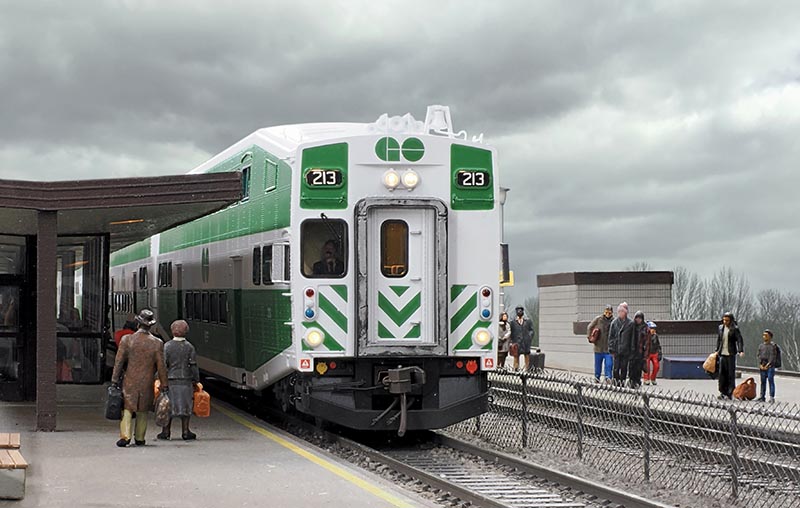
ABOVE: GO Transit cab car No. 213 was delivered in 1983 and received ditch lights in 1984. Jason’s nominal 1980 modeling era remains flexible when necessary, stretching from the late 1970s through the mid-1980s. The GO Transit train is a Rapido model.
In November 2022, Jordan Smith, a longtime Rapido employee and one of my closest friends, joined me in removing the Kingston Mills and Guildwood benchwork and building a new section for Guildwood. I replaced Kingston Mills with a simpler scene, and in May 2023 finally began work on the expanded station. I was determined not to compromise. That led to a fateful decision: I would not use selective compression. My favorite station would be modeled in its entirety, just as I remembered it.
Project Scope
In the grand scheme of things, Guildwood is a very small station. What is small in reality is truly enormous in HO scale. The platforms are each about 126 inches long. As the platforms are offset, the total platform length on the layout is more than 150 inches long — more than 12 actual feet. The modeled parking lot — a slice of the real thing — has space for almost 130 cars!
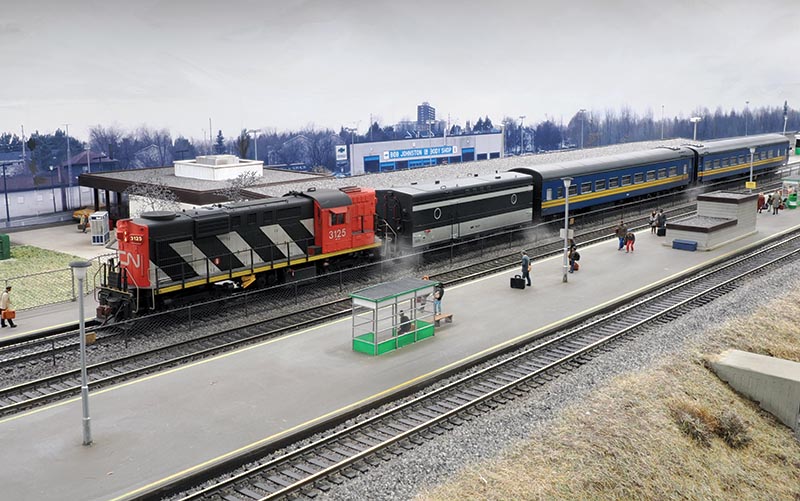
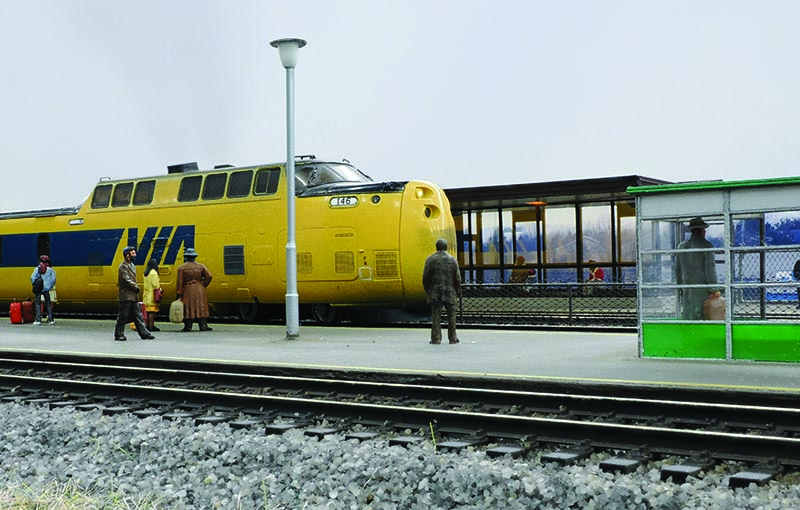
ABOVE: The morning Rail Diesel Car (RDC) service, the Ontarian, was occasionally replaced by conventional equipment. On a cold day in December 1979, an ex-Canadian National SGU (steam generator unit) is needed to keep VIA passengers warm because the borrowed RS-18 lacks a boiler. Freight locomotives regularly powered VIA trains during the late 1970s and 1980s.
My determination to recreate Guildwood in its entirety did not end with the station’s length. I also have especially fond memories of the two pedestrian tunnels beneath the tracks. Walking through the east tunnel to Platform Two meant we were boarding a train for Montreal, since westbound trains from Montreal almost always arrived on Track 1.
I remember the colorful “action striping” along the walls, the whine of the fluorescent-light ballasts, and the echo of my footsteps as I ran through the tunnel making as much noise as possible. Nostalgia is a powerful motivator, and I wanted to model both tunnels in full. Their height determined the elevation of the subroadbed, so I built the tunnels first…
