

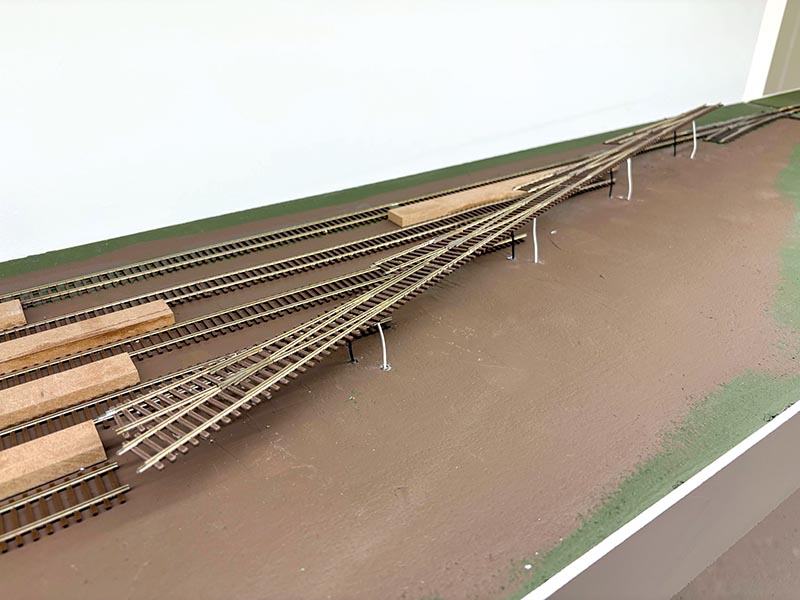
 I just finished re-laying the yard on the Chicago & North Western level of my three-tier layout, based on my hometown of Wausau, Wis., as it appeared in the late 1960s through the mid-1970s. I spent an hour prying apart the suitcase connectors to free the feeds to several sections of Code 55 track and eight Code 70 turnouts. After that, it was carefully separating from the caulk adhesive the same said track and ground throws with a putty knife. In that process, I also managed to peel away a hand-sized section of the painted paper from the ceiling tile base in the process. After that, I had to fill the wire holes and smooth over the paper-less tile section with spackle. Tomorrow, I’ll be back in the train room to repaint the area brown.
This do-over is my fault. All of it.
Turns out I wasn’t paying close enough attention to track centers, and I ended up with two tracks where box cars would not clear one another. The fix couldn’t be had with a few tweaks; the whole darn yard had to come up. So up the whole darn yard came. What’s worse is that I laid this yard after I had finished the first yard using the same brand of Code 55 track and Code 70 turnouts on the Milwaukee Road level of my layout. And I still managed to screw it up with that practice behind me.
While I do feel a little foolish about it, I’m kind of, sort of, okay with that blunder.
I’ve been a teacher and administrator for the last 35 years. For years, my students have heard me preach, “Pain is the touchstone of growth,” and “You have to make yourself comfortably uncomfortable in order to grow,” and “Human beings are wired to engage in problem-solving.” Since I got back into model railroading in 2018, those three mantras have applied to me. I’ve also been reminded that it’s so much easier to give advice than it is to be subjected to said advice.
The most engaging kind of problem-solving, at least for me, comes when you have to be both creative and analytical while working within constraints. As much as I’ve tried to convince myself that I had carefully thought things through, I’ve still managed to make plenty of mistakes along the way.
I started buying buildings, track, and rolling stock a few years before construction of the layout began in early 2022 — well before I had a firm plan in place. Take the Walthers “City Station,” for example. It’s based on the Milwaukee Road depot in Wausau and seemed tailor-made for my layout. There’s just one problem: it won’t fit. Or more accurately, I could force it to fit, but it certainly wouldn’t look right. A cold storage facility kit that was originally intended for the Milwaukee level also didn’t work there; it has since migrated to the C&NW level, where I’m still trying to come up with a suitable name for it.
As I’ve begun pulling my now-150-plus pieces of rolling stock out of their boxes, I’ve also discovered that a few cars carry service or build/rebuild dates later than mid-1976 — the point when the Alco and Fairbanks-Morse eras ended on the Milwaukee Road and the C&NW, which is central to my layout’s time frame. Now I’m faced with a choice: ignore the dates, weather them out of sight, or sell the cars and replace them with something more appropriate.
There are a lot more mistakes ahead of me because of the constraints of my inexperience. I have never used an airbrush. I have never weathered a car or locomotive. I have never programmed a locomotive. I have never painted track. I have to replicate my era’s wobbly, weedy track on both levels, including attaching hundreds of angle bars. I have never done scenery.
And I’m okay with that right now. Because, at least in theory, there’s plenty of room for hope.
What’s more, the C&NW yard works perfectly now.
—Andrew S. Nelson