
 By George Riley
Originally constructed in 1863 in Ruby City, Idaho the entire hotel was moved a mile to Silver City, Idaho when the former lost its status as the county seat of Owyhee County and the seat moved to Silver City in 1866. In 1868, the hotel received piped in running water from a local spring and additions continued to be added on to the original structure. This included a five-story annex which housed not only additional rooms for guests, but also an elegant dining room. As with most businesses situated in mining communities, The Idaho Hotel was subject to the vagaries of metal prices which included the Silver Panic of the 1890s. The hotel’s last improvement occurred in 1901 with the completion of a storage tunnel which connected with a mining tunnel. In 1942 the hotel finally closed with Silver City being mostly abandoned and becoming a veritable ghost town.
However, the now semi-derelict hotel was purchased in 1972 by Edward Jagels who over the next thirty years methodically began restoring this historical building. The current owners acquired the once grand hotel in 2001 and have continued with its preservation. Of the original 40 rooms, 13 have been rehabilitated and are available to rent.
In the late 19th century, hotels provided more than transient lodging. Traveling salesmen or ‘Drummers’ would set up their wares either in their own rooms or in the case of The Idaho in a ‘Sample Room’. Often single managers and miners would take residence in these hotels which with their grand dining rooms and well-appointed kitchens were many levels above the usual boarding houses and miner’s cabins. In small towns, the local hotel also served as the community center.
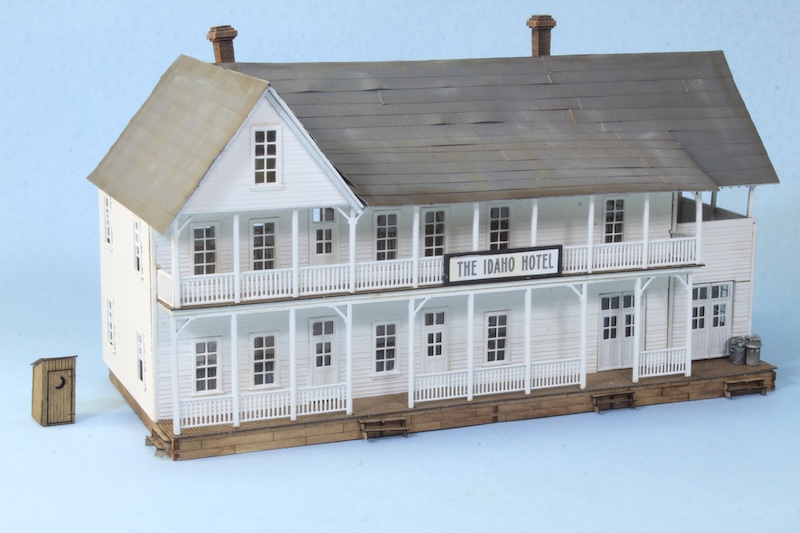
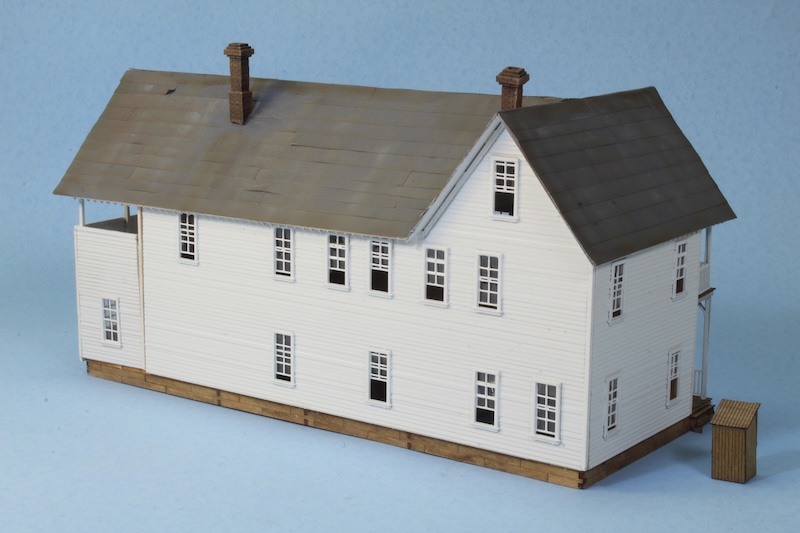
The Idaho Hotel laser cut kit was Bar Mills’ first offering. This updated kit represents The Idaho as it appeared in the 1860s through early 1880s. The current model is a redesigned version of Bar Mills’ original model now featuring simplified construction and now includes injection molded windows and doors that complement the precision cut basswood, plywood, and chipboard components. Many of the smaller parts feature peel and stick backing that makes for a very quick and neat application. Noteworthy of these are the sections with the laser-cut rafter tails and the laminated two-story porch railings. Laser-cut roofing strips make quick work of finishing the roof covering which features multiple valleys and gables. A pack of diecast details which feature a pair of chimneys, and a quartet of trash cans round out the kit components. The kit is complete right down to the laser-cut glazing and one hole outhouse! All the modeler needs to successfully assemble this model is paint, glue, a sharp modeling knife and a sanding block or salon board…