
 Story and Photos by George Riley
Standardization is one way of increasing efficiency and at the same time adding to the bottom line. At the turn of the last century, Pennsylvania Railroad set out to design a series of standard locomotive designs that could operate on any section of the system. Out of this design and construction campaign, a number of well-designed and amazingly long-lived steam locomotives would be fielded.
Among these was a group of unheralded 0-6-0 B6 class “shifter” locomotives. Designed as the road’s “heavy” switch engine, these would be constructed in three distinct subclasses, with the first emerging in 1902. Between 1902 and 1912, 79 B6 locomotives would join the Pennsy roster. These engines featured Belpaire fireboxes, 56-inch drivers and Stephenson valve gear. In addition to being built in-house, a number were also constructed by Baldwin and Lima.
The next group, the B6sa, joined the fleet between 1912 and 1913 with the addition of 55 units. These featured super heating, Walschaerts valve gear, and radial-stay fireboxes. These in many ways could pass for the later 0-6-0, of which Pennsylvania’s design team would have more than a passing interest in the development of United States Railroad Administration’s common designs.
The final B6 group consisted of 238 engines designated as the B6sb subclass. These locomotives had all of the upgrades associated with the B6sa subclass with the return to using the Belpaire firebox which was common to Pennsy’s in-house designs of the time. Both the B6sa and B6sb classes would be retrofitted with power reversers that made changing direction faster and easier on the engine crew. The B6sb would become the pinnacle of the Pennsy’s 0-6-0 designs. So successful was this type that the last Pennsylvania steam locomotive in operation was B6sb 5244, operating in New Egypt, N.J., where it dropped its last fire in July 1956.
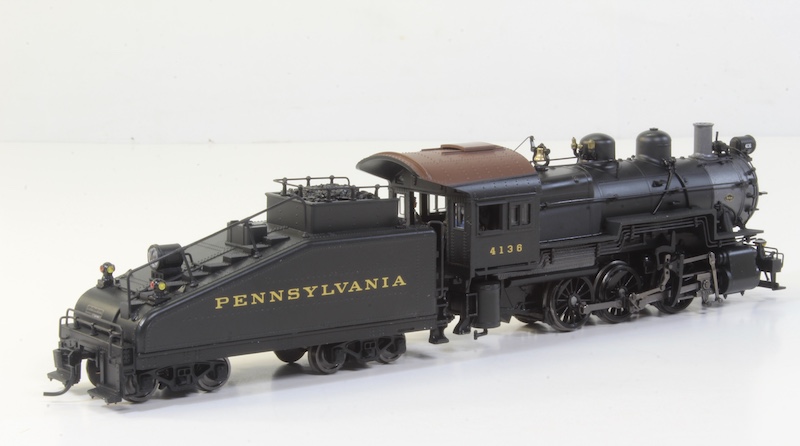
As with most steam locomotives when emerging from shop visits, they frequently received different tenders than their original ones. While the B6s were usually assigned small slope-back tenders which gave better visibility for reverse moves, they often were mated to rectangular tenders, particularly those from retired H3 Consolidations.
While usually up to the task initially, but as train weights increased, downgraded H class Consolidations filled in for the heaviest work in hump and the larger classification yards; however, the B6 locomotives continued to be useful until steam left Pennsylvania’s rails. Two examples still exist. PRR B6sb 1670 is now part of the Railroad Museum of Pennsylvania’s collection, while B6sa 60 has been cosmetically restored and is currently on display in Lewes, Del.
While smaller locomotive models are frequently overlooked by manufacturers in favor of larger road engines, Broadway Limited Imports continues to produce many of these smaller machines that fill in the gaps of many model railroad rosters. The Pennsylvania Railroad B6sb is the latest of these releases.
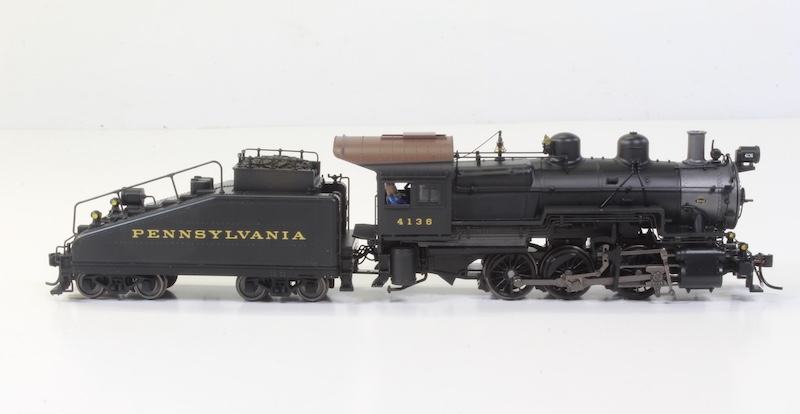
Out of the box, the fit and finish of this model is neat and precise, matching the dimensions found on company erecting drawings closely. Photos searched online of PRR 4136 matches the model as offered. PRR 4136 was a product of Juniata Shops in Altoona, Pa. Built in 1916, the 4136 was the second locomotive to carry this number. It was retired and scrapped in October 1956, having had a nearly forty-year career.