
 To most rail historians, the advent of commercial aircraft is in large part to blame for the decline of passenger trains in North America. However, the relationship between railroads and aviation is more nuanced than it first appears. Few realize that the transport of large aircraft subassemblies have taken place reliably for over a century on America’s railroads. The transport of aircraft components began in the 1900s on flatcars and in specially-equipped boxcars. After the first seven 737s were built in Boeing’s assembly plant in Renton, Wash., in early 1966, it was decided the primary fuselage sections would be built at Boeing’s plant in Wichita, Kan., then transported 1,800 miles by rail to Renton for final assembly.
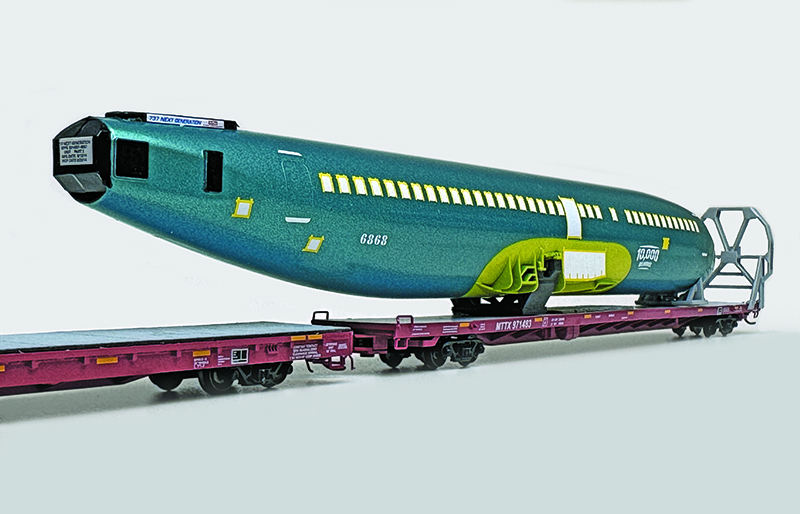
For the next 30 years, over 1,000 Boeing 737 fuselages were transported as separate forward and aft subassemblies on paired flatcars by rail. In 1996, Boeing unveiled an updated “Next Generation” version of the 737 called the 737NG. With this came new manufacturing techniques and efficiencies which included the entire fuselage shipped as a single complete unit from Wichita to Renton using a specially-modified 89’ flatcar mated to a buffer flat. Soon after, Boeing’s 737NG family and its progeny proved to be an even greater success than the first-generation 737s. In February 2018, the fuselage of the 10,000th Boeing 737 was transported by rail from Wichita to Renton using cars MTTX 971483 and BNSF 800012.
Stacked from 6 images. Method=C (S=4)
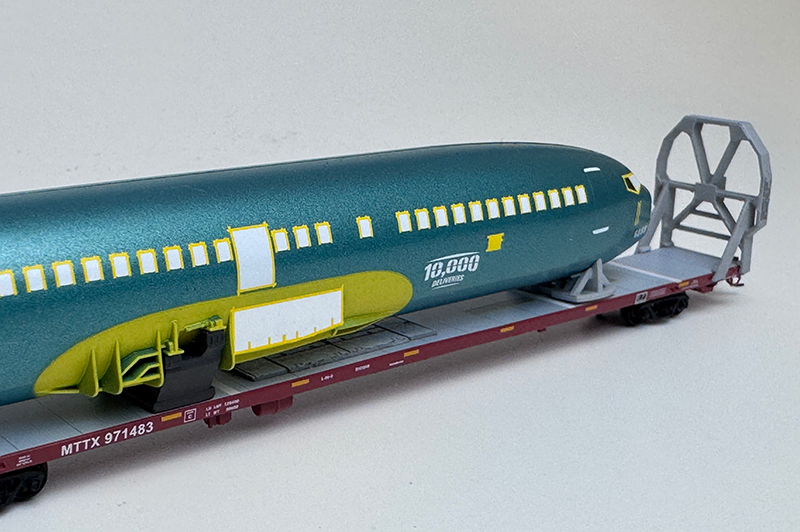
Micro-Trains has released a kit enabling modelers to recreate this momentous occasion. Presented in a sturdy cardboard box, the ensemble includes two flatcars with individual clear plastic jewel cases, load securement devices, a prepainted fuselage, waterslide decals and full-color instructions. The first flatcar (MTTX 971483) is a good representation of TTX class BH20AB, a Bethlehem-built 89’ flat modified for fuselage transport. Also included is BNSF 800012, a 60’ flatcar used as a buffer car. All lettering and artwork is presented crisply throughout. Thin laserboard appliques with printed artwork are provided to represent the light gray “steel” decks for both flatcars. I secured the deck to the 60’ flat with a thin coat of canopy glue.