

 “The narrow gauge gets in the blood, and will not out.” —David P. Morgan.
The “narrow gauge” Morgan refers to is the famed 3-foot-gauge lines of the Denver & Rio Grande Western in Colorado and New Mexico. Constructed in the 1870s and 1880s, it was a result of the region’s silver and gold bonanza. By the early 20th century, hundreds of miles of narrow-gauge railroad criss-crossed the mountains, forming a circle through the state that would attract fans for years. Even after D&RGW decided to standard-gauge much of its main line, it maintained the narrow gauge operations long after most had been abandoned.
By the 1950s, all that was left was the San Juan Extension into the mountainous region of southwest Colorado and northern New Mexico. The line ran from Alamosa to Durango with branches to Silverton and Farmington. By then, the 45-mile branch to Silverton had been turned into an excursion route, attracting enthusiasts and the general public looking for a piece of the “Old West” through the spectacular Animas Canyon. The rest of the railroad was on its way toward abandonment until a pipeline project near Farmington gave it a new, albeit brief, lease on life into the late 1960s. The Rio Grande knew that the pipe traffic was a good opportunity for it, but that it wouldn’t last forever. Instead of converting the route to standard gauge, the railroad brass opted to keep the tired narrow-gauge railroad under steam just a little bit longer.
That decision proved critical to its preservation. After the last freight run in 1968, the Rio Grande moved most of the surviving equipment to Durango for continued use on the Silverton Branch excursions. But the states of Colorado and New Mexico saw an opportunity in the equally scenic section between Chama, N.M., and Antonito, Colo. The states stepped in to buy the line and, in 1970, opened it up as the Cumbres & Toltec Scenic Railroad. Since then, the C&TS and Durango & Silverton (which took over the Silverton line from Rio Grande in 1981) have kept the memory of the narrow gauge alive by operating two portions of it much the way it was run a century ago.
As a native of Maine, I’ve long been a fan of narrow gauge railroads. How could I not in a place that once had five 2-foot-gauge common carriers? But it wasn’t until 2017 that I became acquainted with the Rio Grande’s version. With some friends, we drove to Colorado and spent a few days on the D&SNG, riding and photographing the multiple trains a day that departed from Durango behind 2-8-2 locomotives, most notably the three surviving K-28 types. The D&SNG is an impressive operation — in 2023, it carried more than 245,000 passengers — and operates like a “big” railroad. Like a major Class I, it’s hard to get up close and personal with the railroad at times. The best view you’ll get of your locomotive being readied for its run up the Animas is a distant glimpse from the platform. It’s nonetheless impressive, and standing trackside or riding will give you a great sense of what the Rio Grande was like in its glory days.
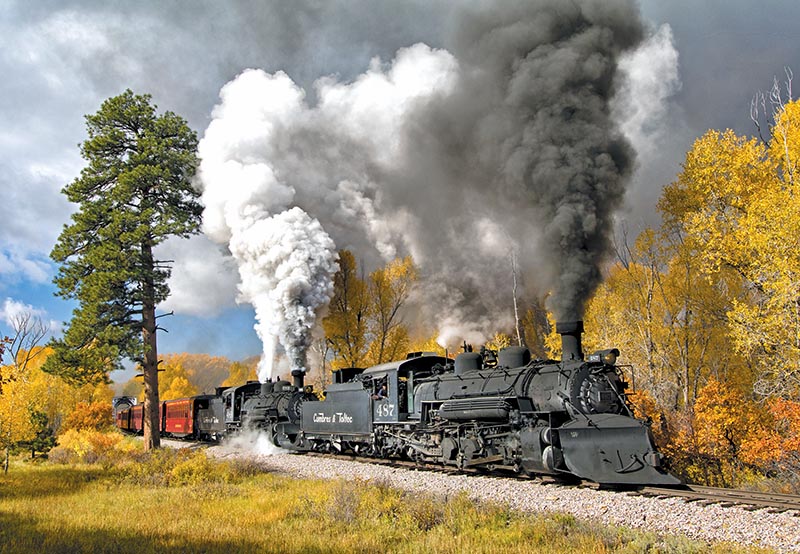
But a few days later, we ventured farther east along the old San Juan Extension to Chama and the Cumbres & Toltec. Chama is a small town, population 900 or so back in 2020, and as such, things are a little looser. You can easily walk the yards unsupervised and get up close and personal as locomotive hostlers — some of whom had parents and grandparents who worked for the Grande — ready the locomotives. The most popular on the C&TS is the K-36. The 480-series locomotives were not the smallest or the biggest, but they might have worked the hardest. Ten K-36 2-8-2s were built by Baldwin in 1925; nine of them still survive today (four on the D&S and five on C&TS).
Watch the hostlers prepare a pair of K-36s for the climb up Cumbres Pass and you’ll immediately understand what Morgan was talking about. Steam locomotives are already impressive machines to watch at work, but with outside-frame drivers, it seems as if there’s even more to digest when watching these engines. And while these aren’t small locomotives by any means — 187,100 lbs. on those inside drivers — they’re small enough that it seems you can really wrap your mind around all that’s happening.
And if you’re still not convinced, venture just outside of town to the famed “Juke’s Tree” shortly after the 10:00am departure. Watch as two K-36s storm out of town, working as hard as they ever did during the steam era, and you’ll see why the narrow gauge gets in the blood and will not out. —Justin Franz
