

 Every so often the discussion of layout size comes up among modelers debating what path to take in the hobby. Are big layouts inherently better than small, or vice versa? Can big be too big? Small, too small? My response: In terms of iron, anything is better than nothing, especially if it moves!
In my view, this hobby is haunted by “armchair” modelers who fill closets, even entire rooms, with boxed trains, yet never, ever, lay an inch of rail, strip a millimeter of wire, or cut one sliver of benchwork. Past RMC editor Tony Koester beautifully summed up this phenomenon as the “Someday Central.”
To a small degree, I plead guilty. Ever since I packed up my boyhood trains nearly 50 years ago, I kept them. “Someday,” right? Building that dream model railroad took a backseat as I developed other interests (and obligations) that demanded plenty of my available time and space.
“Someday” finally hit when my stepdad plunked a brand-new model of Union Pacific “Big Boy” 4-8-8-4 4014 on his mantelpiece. “We should run that thing, Dad!”
“Someday, kid.”
Just days later, my dad spotted a newspaper announcement for a modular setup at a nearby mall, with the public invited to bring their trains to run. The curves were too tight, but running 4014 back and forth lit long-dead embers for us both. We got a club spec sheet and went to work building our first module.
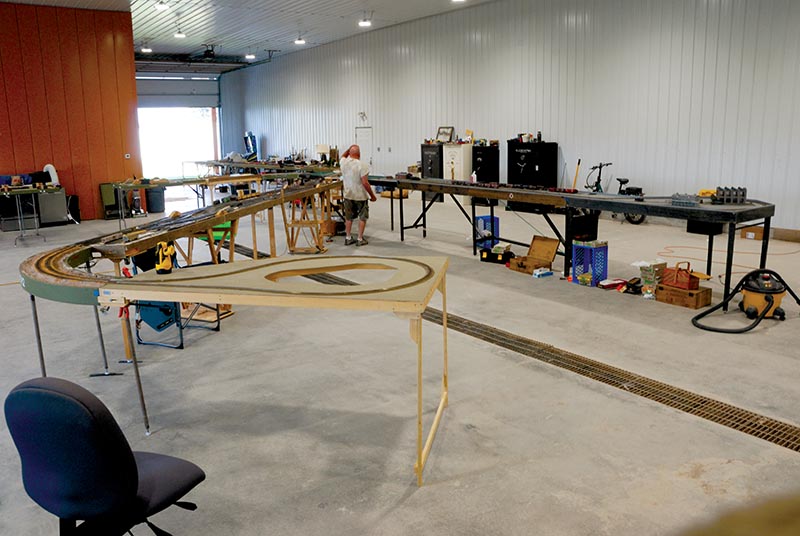
My dad passed before we could finish that first one, but I’ve since built, modified, and/or rebuilt 19 module units. Combined with other members’ modules and excellent teamwork, everything bolts up into a real, working model railroad. Operationally, the result is amazingly realistic, and different every single month. For the other 29 days, my stuff happily stacks into a corner, ready for the next group run.
Better than nothing? Heck yeah!
Getting started in modular railroading is far easier than beginning a conventional layout. Building your 2×6-foot part of a shared, always-new 20×60 empire is like tasting forbidden fruit – more, please! Building that 20×60 empire alone? Very few people can sit down and finish a twelve-course meal alone.
Standard designs such as Free-Mo in both HO and N, plus the original NMRA modular, N-trak, or T-trak, are long established. Some vendors even offer laser-cut kits compatible with these popular standards. I firmly believe any modeler able to finish a kit decently could pop together a module and have it fully ready to run well inside two weeks of evenings, tops, much less with competent mentorship. Your final contest-winning touches will take longer to master, but you’ll build all the skills needed when, yes, you finally score that giant, perfect basement with a house on top. Framing, wiring, scenery, track, even maintenance is a breeze when you can comfortably reach and work on any item from any angle. What if you make a complete mess? It’s only two-by-something – tear it up and try again!
A few caveats are worth mentioning. First, sloppy railhead height or track spacing at the standard module interfaces just won’t fly. Your work must join perfectly with modules built somewhere else by someone else — and that can be surprisingly tricky. Seek advice from experienced builders early on.
Second, strength is essential, but must be balanced against weight. Your modules will venture into a world far tougher than any basement or train room. Materials that work fine at home may fail in the realm of self-closing doors, textured concrete floors, and fast-moving, unsupervised kids (and adults). Think of your module as portable equipment: rugged enough to survive repeated handling, yet light enough for one person to carry, set up, and take down. Build something sturdy and portable that “plays well with others,” and that’s when the ridiculous, addictive fun begins.
One last thought: as long as you’re able, you can take it with you. Well-built modules slide safely into a moving van and arrive ready to run. And when you’re no longer able? Others can take them on and enjoy them for years to come. I once had 19 modules; now I have six. Instead of going in a dumpster, each is rolling out the door to what I hope will be happy homes and long, useful lives.
That, to me, is way better than nothing.
—Dave Skinner
