

 by Cameron Nealy/photos by the author
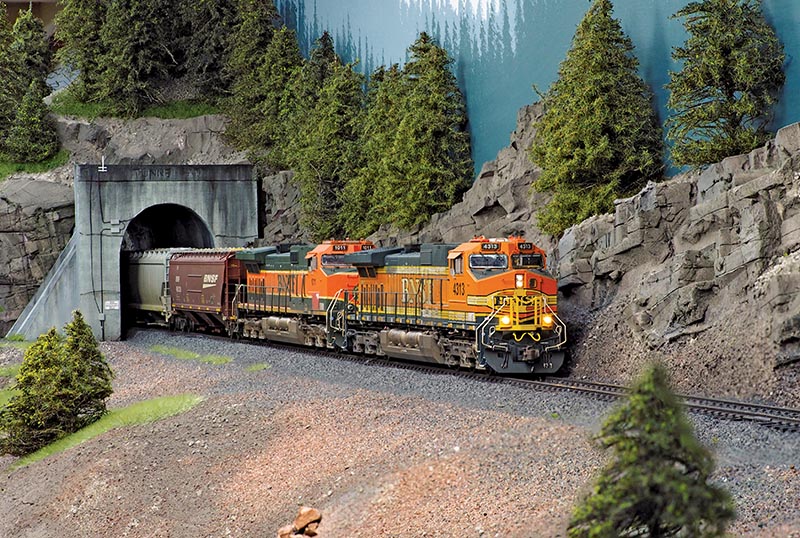
I will forever be captivated by the magic of big-time modern railroading in scenic locations. Trains more than a mile long and in excess of 15,000 tons battling steep mountain passes produces a drama that is unparalleled by anything else. To some, modern main line railroading is a display of monotonous machinery and logistics, but select routes just refuse to underwhelm. BNSF Railway’s Marias Pass in northwestern Montana pairs fascinating operations with scenery so grand in scale that it dwarfs the enormity of even the biggest road freights, and I’ve attempted to model this mountain main line in a 12×28 ft. layout space.
An Overview
Covering roughly 200 linear feet of HO scale main line across two levels of benchwork, the layout spans the far western end of the BNSF Hi Line Subdivision from Whitefish, Mont., to the summit of Marias Pass. The result is a layout with only six distinct scenes that is large enough to keep five to six operators busy but still manageable enough to entertain a single operator. The operational heart of the layout is the movement of unit trains such as crude oil, grain, and coal from one end to the other, and to me, the highlight is watching manned helper sets based at Essex help move these trains over the pass.
The helper operations were my primary focus when designing and constructing the layout, but switching operations aren’t overlooked either. The yard at Whitefish and industry at Columbia Falls provide ample work for crews as they labor to move lumber products on the front end of the supply chain to off-layout points east.
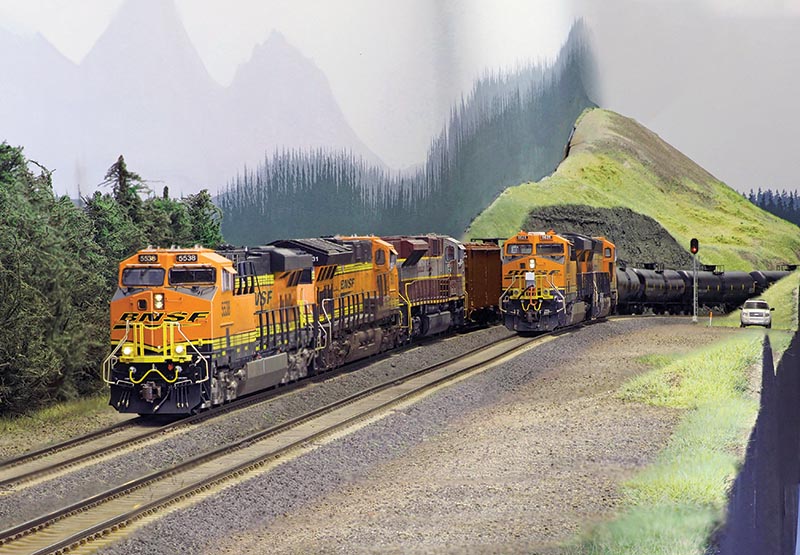
ABOVE: Eastbound empty tank train U-PTWBER1-08, complete with a Canadian Pacific SD70ACu, crests the top of Marias Pass. The Essex helper set, symbol K-ESXESX1, is fresh off a push and waits for signal indication to head back down the grade.
However, the Marias Pass layout that you see today, including all the benchwork and most of the track arrangement, was originally clad in scenery intended to represent another manned helper district: BNSF’s Crawford Hill in northwestern Nebraska. So, how was I able to construct what is essentially a new layout without tearing down the first?
Original Concept
In 2013, I became fascinated with manned helper operations. My exposure to the concept came when I was poring over John Parker’s magnificent BNSF Fall River Division layout. His use of a dedicated manned helper set over a stretch of his main line captivated me, and from that point forward, I knew I wanted to do something similar.
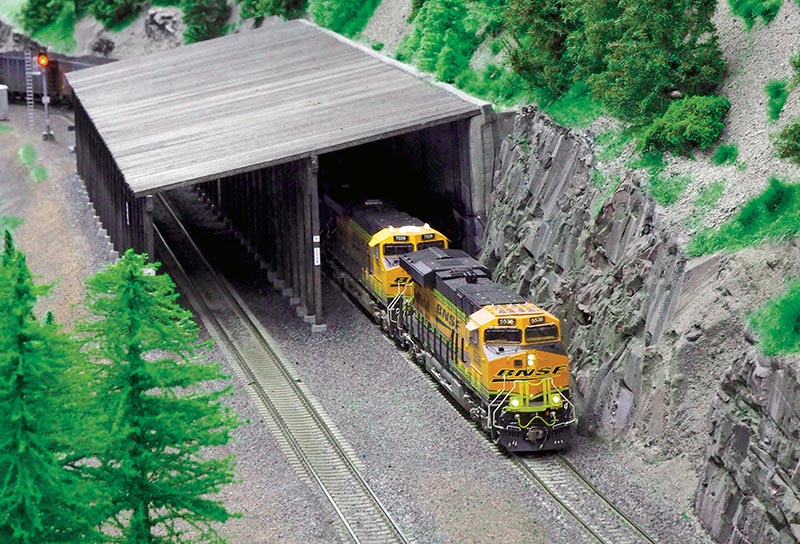
ABOVE: BNSF ET44C4 5538 ducks out of Snowshed No. 5 with detoured black diamonds bound for Roberts Bank, B.C., in tow.
I embarked on a mission to build an HO scale layout with maximum main line potential and steep mountain grades that would necessitate manned helpers as a part of the layout’s operational DNA. Ultimately, I settled on the general layout design you see today with two decks and no helix; the “no-lix” design utilizes the main line grade to climb between the first and second deck. I also opted to include a peninsula, which limits aisle space for operators but increases the main line run and reduces the required gradient to climb from one deck to the other.
After shopping around for a suitable real-world example of helper operations, I believed that the Butte Subdivision over Crawford Hill was the perfect place to model. It’s an exciting stretch of high tonnage main line that primarily features Powder River Basin coal traffic. All day, multiple manned helper sets help shove eastbound loads up the 1.55 percent grade, so what’s not to love? Truly, the prototype is fascinating, but hasty layout planning and execution left me unmotivated to progress further.
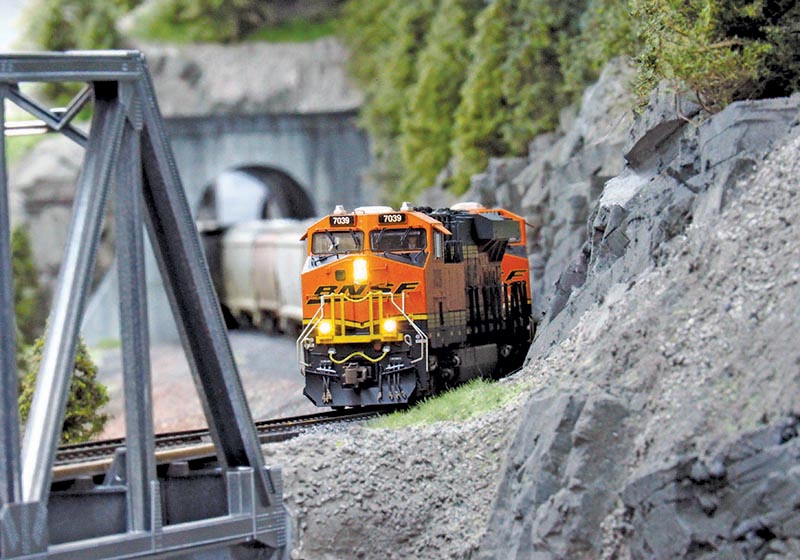
ABOVE: At Belton, BNSF 7039 is about to span the Middle Fork Flathead River while holding back the weight of westbound canola seed loads bound for Modesto, Calif.
Nebraska to Montana
As time went on, I became increasingly interested with railroading in the Rocky Mountains, and Marias Pass captured my attention during a 2019 railfan trip with my grandpa and dad. The mild early summer temperatures, lush green scenery, and mountaintops disappearing on misty days became my “happy place.”
As I became familiar with certain photographic locations along Marias Pass I realized that the physical orientation of many scenes on my Crawford Hill layout could be transformed into shockingly recognizable perspectives on the Hi Line Subdivision. Perhaps the most serendipitous element of my re-design — and an element that served as the proverbial last straw — was realizing that Essex could be modeled where the Crawford helper base already sat on the shelf above the yard. This was a motivating realization because Essex is still used as a manned helper base on the real Marias Pass, and it could be modeled on the midpoint of the main line grade just like the prototype.
So, after eight years of modeling Crawford Hill, I made the decision to rip out all of the Nebraska scenery and start from scratch. And as a testament of the commitment to this major refocus, my dad, who has helped build the layout, even designed a sharp layout logo with elements inspired by Marias Pass’ Great Northern heritage…
